
EMA Cross Strategy
Description
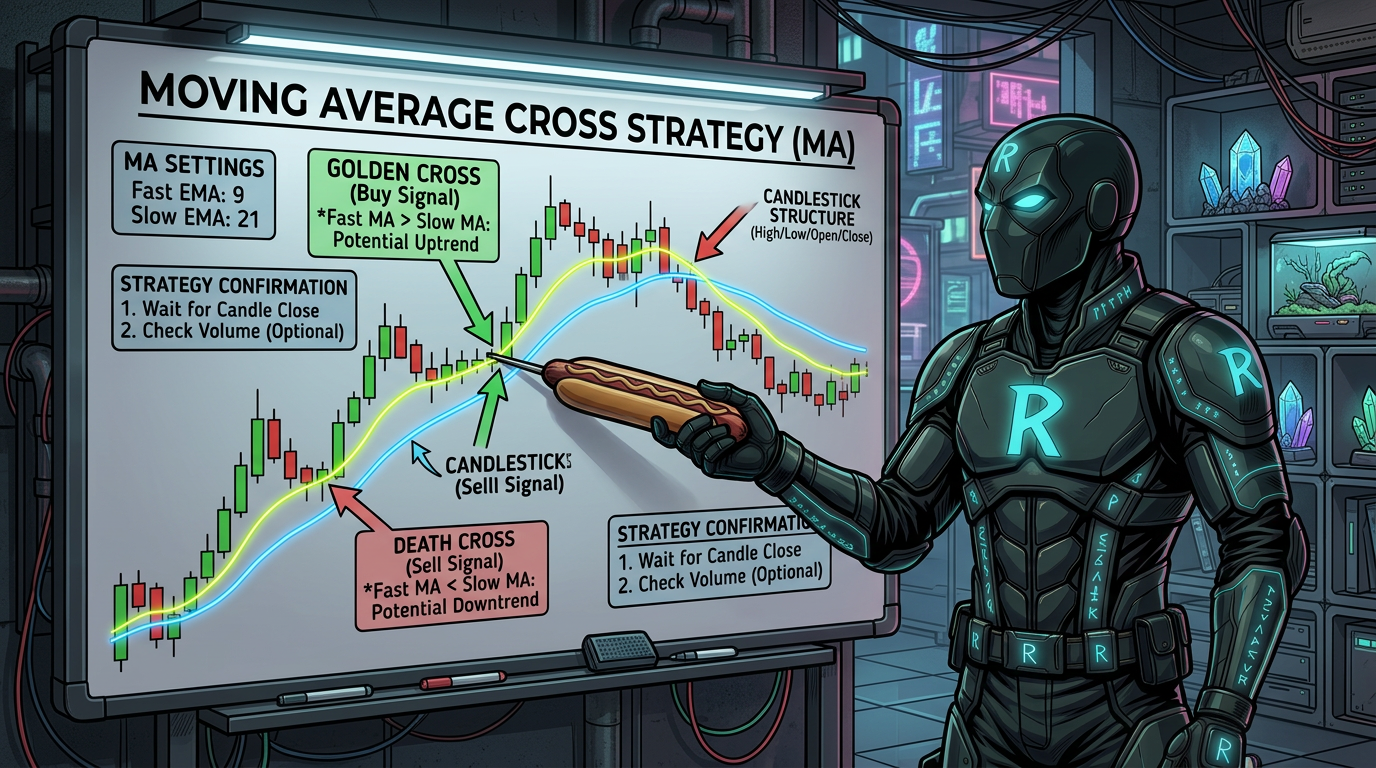
This strategy uses two moving averages to find trade opportunities. When the faster 20-period line crosses above the slower 50-period line, you buy. When it crosses below, you sell. You can also use the moving averages as support and resistance levels, entering trades when price returns to them and a momentum indicator confirms the move.
Market Conditions
- Market has a historical tendency to follow MA crossover signals— Zoom out and verify that past crossovers resulted in sustained directional moves. Avoid markets where price repeatedly ignores or fades the crossover.
- Trending market environment on the selected timeframe— Crossover strategy produces excessive false signals in ranging markets. Only apply on timeframes and instruments showing clear trend behavior.
- Price above 200 EMA for longs, below 200 EMA for shorts (when using 200 EMA filter variant)— Used as an optional bias filter to increase win rate when combining with other indicators such as Supertrend or Parabolic SAR.
Setup Sequence
- 1
Select higher timeframe chart
Choose the Daily or 1-Hour chart. Lower timeframes have more ranging conditions and produce excessive false crossover signals.
- 2
Apply 20 and 50 period moving averages
Use only two MAs — the 20 and 50 period. Adding more MAs delays entry signals unnecessarily.
- 3
Qualify the market via historical crossover reaction
Zoom out and observe whether past crossovers led to sustained directional moves. If the market has repeatedly ignored or faded crossovers, skip it and find a different instrument or pair.
- 4
Wait for 20 MA to cross the 50 MA
Bullish cross (20 crosses above 50) signals a potential long. Bearish cross (20 crosses below 50) signals a potential short.
- 5
Enter in the direction of the cross
Take a buy on bullish crossover or a sell on bearish crossover on a qualifying market. Do not enter immediately in unqualified or ranging markets.
- 6
Manage the trade with ATR Trailing Stop
Use an ATR trailing stop as the exit mechanism rather than waiting for the next MA crossover. This preserves more profit by exiting closer to the actual trend reversal.
- 7
(Alternative) Trade MA as dynamic support/resistance with Stochastics
If price repeatedly bounces off the moving average, treat it as S/R. Enter long when price returns to the MA while Stochastics is oversold; enter short when price returns to the MA while Stochastics is overbought.
- 8
(Optional) Apply 200 EMA trend filter to any indicator
Only take buy signals from any secondary indicator when price is above the 200 EMA. Only take sell signals when price is below the 200 EMA. Ignore signals that conflict with the 200 EMA bias.
Entry Trigger
Stop Placement
Management Rules
- •Trail stop using ATR trailing stop indicator
- •Ignore crossover signals on markets with no history of crossover reaction
- •Ignore signals from secondary indicators that conflict with the 200 EMA bias
Common Mistakes
- •Entering immediately on every MA crossover without qualifying the market first
Fix: Zoom out and confirm the market has a history of following crossover signals before taking any trade.
- •Trading the crossover on lower timeframes
Fix: Use the Daily or 1-Hour chart where trends are more sustained and false signals are reduced.
- •Using too many moving averages (e.g., 20, 50, and 200 all for crossover signals)
Fix: Stick to only two MAs (20 and 50). More MAs delay entries significantly.
- •Exiting only when the MAs cross over again in the opposite direction
Fix: Use an ATR trailing stop to exit earlier and capture more of the move before the full reversal crossover occurs.
- •Applying the crossover strategy in a ranging market
Fix: Identify trending market conditions first. In range-bound markets, the crossover produces frequent false signals that erode the account.
Frequently Asked Questions
What is the EMA Cross Strategy?
The EMA Cross Strategy uses two moving averages — a faster 20-period line and a slower 50-period line — to spot trading opportunities. When the 20-period line crosses above the 50-period line, you buy. When it crosses below, you sell. It's a way to follow trends in the market.
What does 'qualifying the market' mean before using this strategy?
Before you trade, you should look back at the chart and check if the market has actually followed crossover signals in the past. If the market has a history of moving in the direction of crossovers, it's a good candidate for this strategy. If it hasn't, you should skip it.
Which timeframes work best for this strategy?
The Daily or 1-Hour charts work best. On higher timeframes, trends last longer and there are fewer false signals. Using lower timeframes, like 5 or 15 minutes, tends to produce a lot of misleading signals that can lead to losing trades.
How do you manage risk and exit a trade?
The main exit tool recommended is an ATR trailing stop. This means your stop-loss moves with the price as the trade goes in your favor, helping you lock in profits. You can also set an initial stop below a recent swing low for a buy trade, or above a recent swing high for a sell trade.
What is the support and resistance version of this strategy?
Instead of waiting for a crossover, you watch for price to come back and touch one of the moving averages. Then you use a Stochastics indicator to confirm the move — if Stochastics shows the market is oversold, you buy; if it shows overbought, you sell. The moving averages act like a floor or ceiling for price.
What is the 200 EMA filter and how is it used?
The 200 EMA is a long-term moving average that shows the overall trend. Before entering any trade from a signal or another indicator, you check which side of the 200 EMA the price is on. If price is above it, you only look for buy opportunities. If it's below, you only look for sell opportunities.
What are the biggest mistakes traders make with this strategy?
The most common mistakes are: jumping into every crossover without checking the market's history first, trading on low timeframes where false signals are common, adding too many moving averages which delays your entries, waiting for a reverse crossover to exit instead of using a trailing stop, and trading this strategy in a sideways or ranging market where it doesn't work well.
Why shouldn't you use more than two moving averages for crossover signals?
Adding a third moving average, like the 200 EMA, to the crossover system slows everything down. By the time all three lines line up to give a signal, a big part of the move may already be over. Sticking to just the 20 and 50 keeps your entries timely and clean.