
Swing High — Definition & How to Identify It | runic.tools
Definition
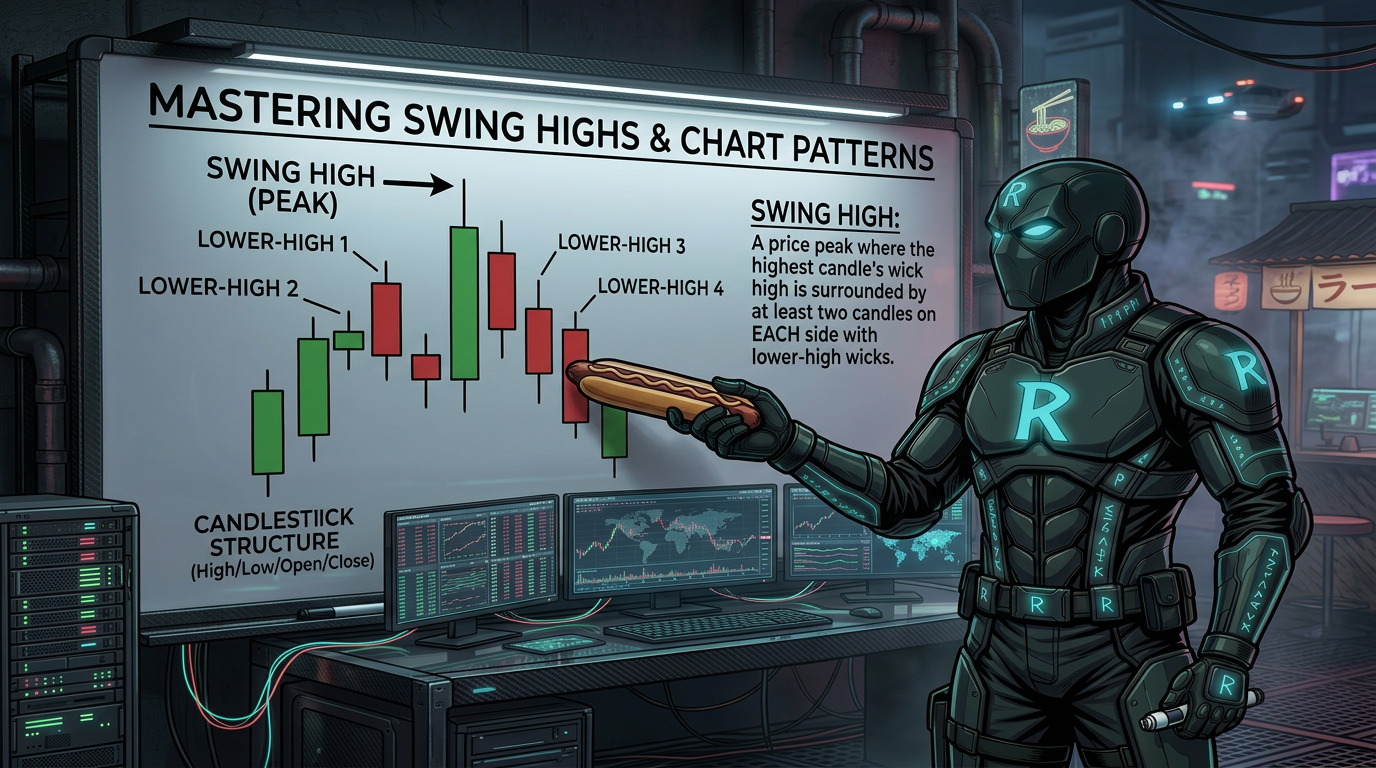
A swing high is a price peak on a chart where the highest candle is surrounded by at least two lower-high candles on both sides. Traders use swing highs to identify trends and key price levels.
Explanation
A swing high forms when one candle's high stands above the highs of at least two candles before it and two candles after it. Those surrounding candles don't have to be in a perfect step-down order — they just both need to be lower than the peak candle. The color of the candles doesn't matter. A red candle can still be a swing high if it fits the pattern. Swing highs are one half of a pair. The other half is a swing low, which works the same way but in reverse — one candle's low sits below at least two higher-low candles on each side. Traders use swing highs to do two main things: identify the direction of a trend, and spot important price levels (called structure levels). In an uptrend, each new swing high should be higher than the last. When a swing high gets broken and price closes above it, that old resistance level can become a new support area. One important note: you can't officially confirm a swing high until two candles have formed after the peak. That means swing highs are better used to prepare for trades — not to predict price in real time.
Example
Price rises to $1.3250, then the next two candles both close with lower highs. Looking left, the two candles before the peak also had lower highs. This makes $1.3250 a confirmed swing high.
Why It Matters
Swing highs are the building blocks of price action trading. You can't spot a trend, draw support and resistance, or plan a trade without them. If you misidentify swing highs, your entire market read will be off. Getting this right is one of the most important skills a price action trader can develop.
Common Misconceptions
Reality: They don't need to be consecutive or evenly spaced. As long as both candles on each side have lower highs than the peak candle, it qualifies as a swing high.
Reality: Candle color doesn't matter. A red candle can be the swing high as long as it has two lower-high candles on both sides.
Reality: A swing high alone is not a trade signal. It's a tool for reading trend direction and finding structure levels. You still need a separate entry reason to place a trade.
Reality: Minor swing highs form all the time and don't tell you much on their own. Major swing highs — the ones that break key resistance levels — are what define trend direction.
Frequently Asked Questions
What is a swing high in trading?
A swing high is a candle whose high is greater than at least two candles before it and two candles after it. It marks a local price peak on the chart.
How many candles do I need to confirm a swing high?
You need at least two lower-high candles on the left side of the peak and two lower-high candles on the right side. That means you can only confirm a swing high after the second candle following the peak has closed.
Do the surrounding candles have to be in a step-down pattern?
No. The two candles on each side just need to have lower highs than the peak. They don't need to be evenly spaced or decrease in order.
What is the difference between a swing high and a swing low?
A swing high is a peak — one candle surrounded by lower highs on both sides. A swing low is a trough — one candle surrounded by higher lows on both sides. Together, they show how price moves up and down over time.
Can I trade directly off a swing high?
Not on its own. A swing high tells you where price has been and helps you read trend direction or spot structure levels. You still need a specific entry reason — like a breakout or a pullback to a key level — before placing a trade.
What is the difference between a minor and a major swing high?
Minor swing highs happen all the time and represent small price peaks. Major swing highs are the ones that break through important resistance levels and confirm a shift in trend direction. Major swing highs are the ones you use to track trend.
How do swing highs help identify a trend?
In an uptrend, each new swing high is higher than the previous one. When price breaks above a prior swing high and closes above it, that confirms the uptrend is continuing. If price fails to make a new higher swing high, it may signal a reversal.
Why does candle color not matter when identifying a swing high?
Swing highs are based on the price level of the high, not whether the candle closed up or down. A red (bearish) candle can still mark the highest point in a swing if the candles around it have lower highs.