
First Candle Five Minute Scalping Strategy
Description
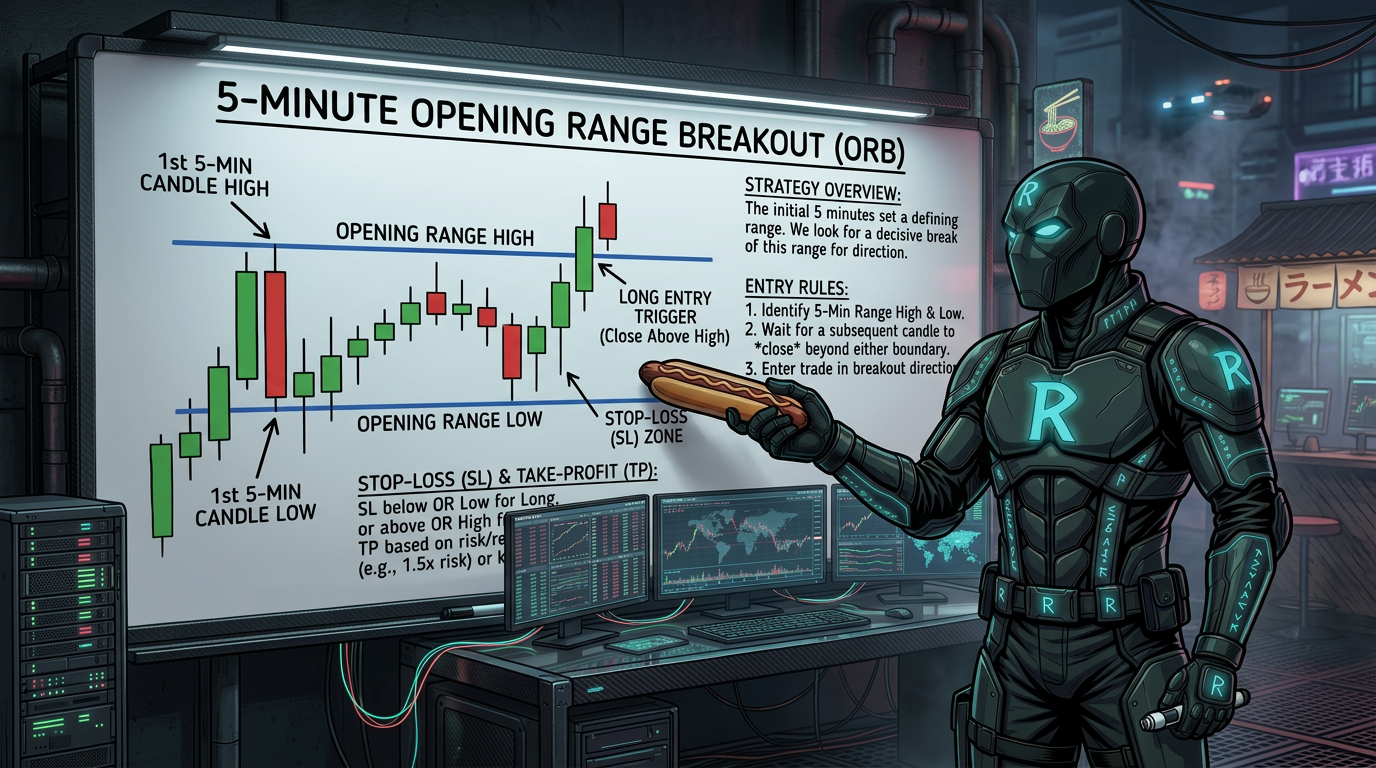
This strategy uses the first 5-minute candle of the trading session as a roadmap. When price breaks above or below that candle and then pulls back to retest the breakout level, you look for a signal to enter in the direction of the break. You place your stop loss just on the other side of the retest candle to limit your risk.
Market Conditions
- New York session open at 9:30 AM ET (or any major session open)— The strategy is built specifically around the first candle of a new session. The same logic applies to other market session opens.
- Strong candle close outside the first 5-minute candle range— A weak candle close outside the range invalidates the setup. Only strong, decisive closes confirm the directional bias.
- Price retraces back to the broken range level for retest— Entry is taken on the retest, not the initial breakout candle. If no retest occurs, there is no entry.
Setup Sequence
- 1
Mark first 5-minute candle high and low
At 9:30 AM ET, allow the first 5-minute candle to fully form. Mark its high and low as the opening range boundaries on the chart.
- 2
Switch to 1-minute chart and wait for directional break
Monitor price on the 1-minute timeframe for a strong candle close either above the opening range high (bullish bias) or below the opening range low (bearish bias). A weak close does not qualify.
- 3
Wait for retest of broken opening range level
After the breakout candle closes, wait for price to retrace back to the broken level (former range high becomes support for longs, former range low becomes resistance for shorts). Look for confluence with order blocks or prior market structure if available.
- 4
Assess confluence at retest zone
Check for additional confluence at the retest level such as an order block, 1-minute range high/low, or prior market structure. Multiple confluences increase conviction in the trade.
- 5
Enter on retest confirmation
For short entries, enter aggressively as price breaks below the confirmation candle low at the retest zone. For long entries, wait for a full candle close above the retest zone before entering.
Entry Trigger
Stop Placement
Management Rules
- •Hold the trade as long as market structure remains intact on the higher timeframe
- •Allow re-entry (reclaim setup) if stopped out
- •Use mental stop with candle-close confirmation as an alternative to hard stops
Common Mistakes
- •Entering without waiting for a candle close confirmation of the breakout
Fix: Always require a full candle close outside the opening range level before considering an entry. A wick alone does not confirm direction.
- •Using a stop loss that is too tight, especially after a large first candle
Fix: Give the trade breathing room by placing the stop at a meaningful structural level rather than just a few ticks beyond the retest candle. A wider stop may require a limit order entry closer to the range level to maintain a 1:2 ratio.
- •Getting stopped out on a hard stop due to a wick and abandoning the trade
Fix: Monitor for a re-entry or reclaim setup. If the candle closes back in the trade direction, re-enter with a new stop and maintain the original directional bias.
- •Cluttering charts with too many indicators (RSI, MACD, Bollinger Bands, VWAP) causing hesitation
Fix: Strip the chart down to price action only. Mark the opening range levels and use candle closes and market structure for all decisions.
- •Taking entries during the breakout candle itself rather than waiting for the retest
Fix: Wait for price to pull back to the broken opening range level. The retest provides a higher-probability entry with a tighter stop and better risk-to-reward.
Frequently Asked Questions
What is the First Candle Five Minute Scalping Strategy?
It's a trading strategy that uses the first 5-minute candle of the trading day as a guide. You mark the high and low of that candle, then wait for the price to break out of that range. When the price comes back to test that level again, you look for a signal to enter the trade in the same direction as the breakout.
How do I know when to enter a trade using this strategy?
You enter when the price pulls back to the level it just broke through and shows a rejection. For a long trade (buying), wait for a full 1-minute candle to close above the support level. For a short trade (selling), you can enter more aggressively when the price breaks below the retest candle's low, without waiting for a full close.
Where should I place my stop loss?
Place your stop loss just on the other side of the retest candle. For short trades, put it above the candle's high. For long trades, put it below the candle's low. Make sure to add a little extra room beyond the key level so a small price spike (called a wick) doesn't knock you out of the trade unnecessarily.
What is the minimum risk-to-reward ratio I should aim for?
You should aim for at least a 1:2 risk-to-reward ratio. That means for every dollar you risk losing, you should have the potential to gain two dollars. If your stop loss is too wide to make that math work, you may need to use a limit order to get a better entry price closer to the key level.
What should I do if I get stopped out of a trade?
Don't give up on the trade just yet. Watch for what's called a 'reclaim setup.' If the price moves back in your original trade direction and a candle closes on the right side of the key level again, you can re-enter the trade with a new stop loss. Keep your original bias in mind.
What are the most common mistakes traders make with this strategy?
The biggest mistakes include entering a trade before a candle fully closes outside the range, using a stop loss that's too tight and getting knocked out by small price spikes, entering during the breakout instead of waiting for the pullback, and cluttering your chart with too many indicators like RSI or MACD. Keeping things simple and waiting for clear signals helps avoid these errors.
Do I need indicators like RSI or MACD to use this strategy?
No. This strategy is based entirely on price action. The advice is to remove extra indicators from your chart and only focus on the opening range levels and candle closes. Too many indicators can cause confusion and make you hesitate when you should be acting.
Why should I wait for the retest instead of entering right at the breakout?
Waiting for the price to pull back and retest the broken level gives you a better entry point. This means your stop loss can be tighter, your risk is lower, and your potential reward is higher. Entering during the breakout itself usually means a wider stop and a worse risk-to-reward ratio.