
Internal & External Range Liquidity — Definition | runic.tools
Definition
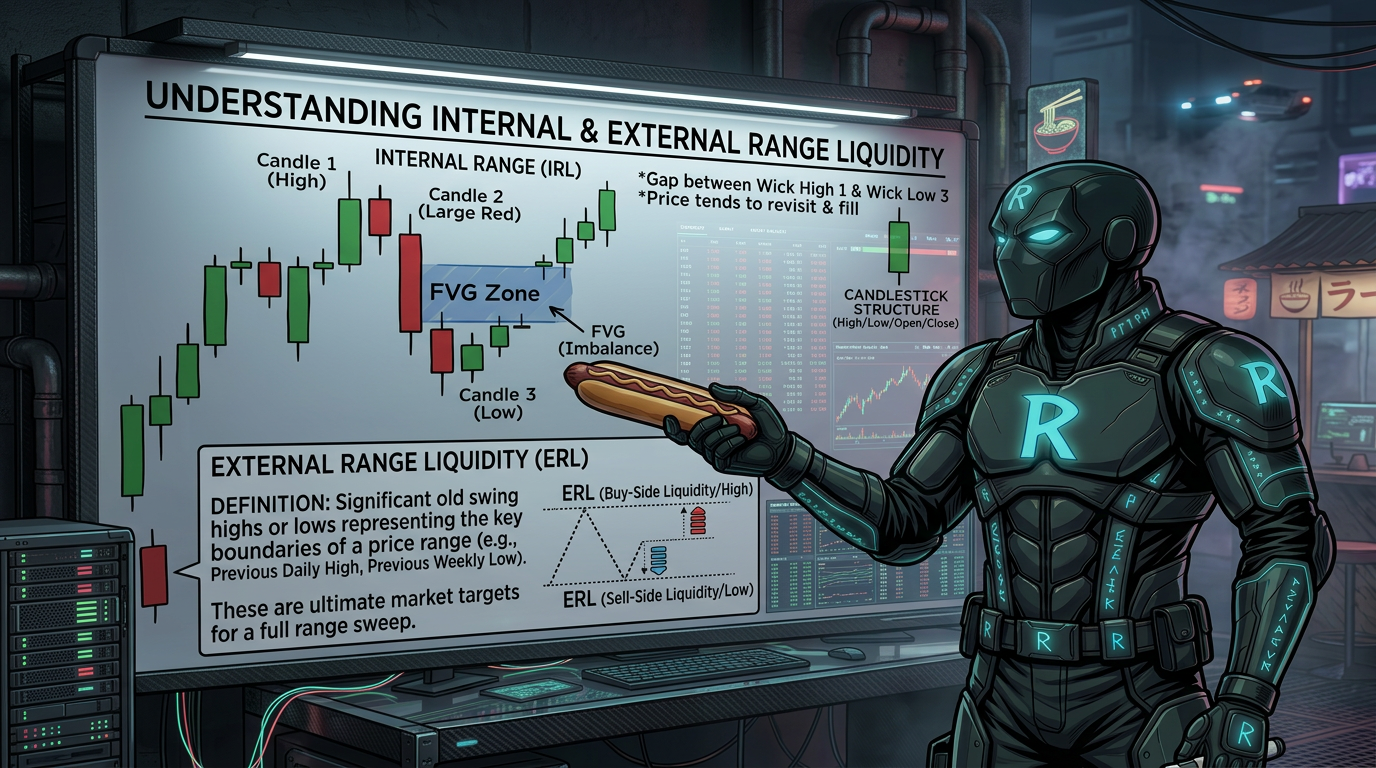
Internal range liquidity is a Fair Value Gap — an imbalance in price that the market tends to revisit. External range liquidity is a swing high or swing low where buy-side or sell-side liquidity rests.
Explanation
The market basically does two things: it hunts old highs and lows, or it fills price imbalances. That is the entire relationship between external and internal range liquidity. After price takes out a swing high or low (external range liquidity), it then seeks to rebalance a nearby Fair Value Gap (internal range liquidity). Once that gap is filled, price turns and hunts the next swing high or low. This cycle repeats on every time frame — weekly, daily, hourly, or even on a 1-minute chart. Traders use this relationship to build a directional bias. For example, if price just swept a swing low and there is a Fair Value Gap above, you can anticipate price moving up to fill that gap. From there, you look for the next swing high as the target. By stacking this logic across multiple time frames — say weekly for direction, 4-hour for structure, and 15-minute for entry — traders can find high-quality setups with defined risk and clear targets.
Example
Price sweeps a swing low (external range liquidity) on the hourly chart. A Fair Value Gap sits above. A trader uses the gap as the draw on price, drops to the 5-minute chart to confirm a shift in structure, and enters long targeting the next swing high.
Why It Matters
This concept gives traders a simple framework to understand where price is likely going next. Instead of guessing, you follow a repeating cycle: external to internal, internal to external. It helps you set a bias, find entries, and pick targets on any time frame.
Common Misconceptions
Reality: Price does not always pull back cleanly. Sometimes it skips a retracement and moves straight to the next level. The framework is a guide, not a guarantee.
Reality: This relationship works on any time frame — including a 1-minute or 5-minute chart. The same cycle of external to internal repeats at every level.
Reality: Not every Fair Value Gap gets respected. When price displaces through a gap without filling it, that gap can invert and act as support or resistance in the opposite direction.
Frequently Asked Questions
What is internal range liquidity?
Internal range liquidity is a Fair Value Gap — a price imbalance left behind by a fast move. The market tends to come back and fill these gaps.
What is external range liquidity?
External range liquidity is a swing high or swing low. These are levels where stop orders and liquidity are resting. Price often hunts these levels before reversing.
How do internal and external range liquidity work together?
They alternate. After price takes out a swing high or low, it moves toward a nearby Fair Value Gap. After filling that gap, it heads toward the next swing high or low. This cycle repeats continuously.
Can I use this on any time frame?
Yes. The internal-to-external cycle works on every time frame, from a weekly chart down to a 1-minute chart. Many traders use a higher time frame for direction and a lower one for entry.
How do I use this to build a trading bias?
Find where price just came from — did it sweep a swing high or low, or fill a Fair Value Gap? Then identify the next likely draw. If price just filled a gap, the next target is probably a swing high or low, and vice versa.
What happens when price displaces through a Fair Value Gap instead of respecting it?
When price breaks through a Fair Value Gap with strong momentum, that gap can invert. It may then act as support if price was moving up, or resistance if price was moving down.
How do I find an entry using this concept?
Use the higher time frame to identify whether price is moving from external to internal or internal to external. Then drop to a lower time frame to look for a structure shift, an order block, or a smaller Fair Value Gap to enter from.
Is this the same as ICT concepts like Smart Money?
Yes, this concept comes from the ICT and Smart Money trading framework. Fair Value Gaps, buy-side liquidity, and sell-side liquidity are all core ideas in that approach.