
Internal Range Liquidity — Definition | runic.tools
Definition
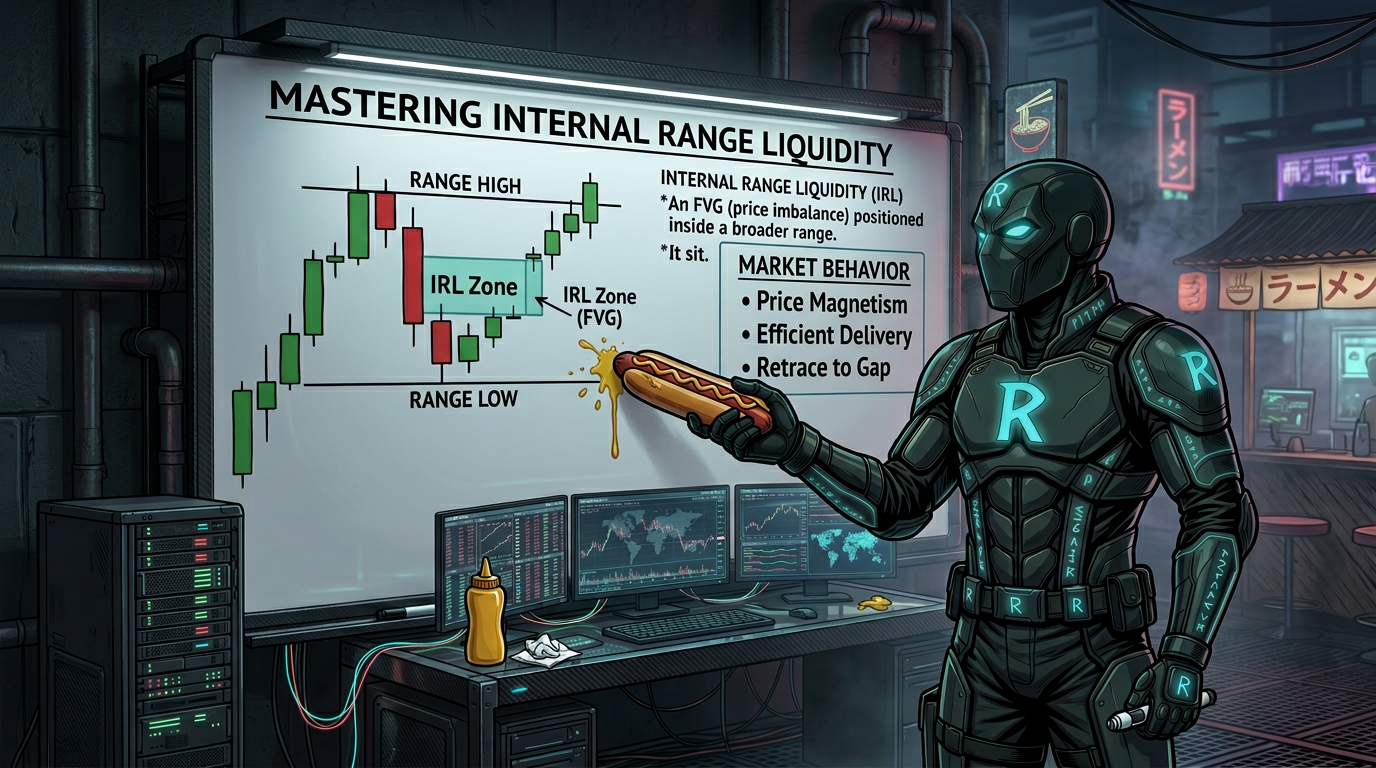
Internal range liquidity (IRL) is a fair value gap — a price imbalance that the market tends to revisit and fill. It sits inside a price range, between external swing highs and lows.
Explanation
Markets do two things: they run old highs and lows, or they fill imbalances. Internal range liquidity refers to fair value gaps — those imbalances. External range liquidity refers to swing highs and lows. The relationship between the two gives traders a simple framework for reading price direction. After price takes out a swing high or low (external range liquidity), it often retraces to fill a fair value gap (internal range liquidity). After filling that gap, price tends to push toward the next swing high or low (back to external). This cycle — external to internal, internal to external — repeats across all time frames. Traders use this on higher time frames like the weekly or hourly to build a directional bias, then drop to lower time frames like the 5-minute or 1-minute to find precise entries. For example, if price on the hourly chart is respecting a fair value gap and pointing toward an old low, a trader can look for short setups on the 5-minute chart targeting that low.
Example
Price sweeps an old high (external range liquidity), then pulls back into a nearby fair value gap (internal range liquidity). Once the gap is filled, the trader looks for a move toward the next old low as the new external range liquidity target.
Why It Matters
Understanding internal range liquidity helps traders know where price is likely to go next. It removes guesswork by giving a structured way to read market direction. When combined with external range liquidity, traders can build a bias on higher time frames and find cleaner, higher-quality entries on lower time frames.
Common Misconceptions
Reality: It shows where price is likely to draw to, not where to enter. Entries still require confirmation on lower time frames, like a structure shift or order block.
Reality: Price often fills gaps, but not always. Sometimes it skips the retracement and moves directly to external range liquidity, especially in strong trending conditions.
Reality: Internal and external range liquidity work on any market and any time frame — from weekly charts down to 1-minute charts.
Frequently Asked Questions
What is internal range liquidity in simple terms?
It is a fair value gap — a price imbalance left behind when price moves quickly. The market tends to come back and fill these gaps before continuing in its direction.
What is the difference between internal and external range liquidity?
Internal range liquidity is a fair value gap inside a price range. External range liquidity is a swing high or swing low at the edges of a range. Price moves back and forth between the two.
How do I use internal range liquidity to find trade direction?
On a higher time frame, identify where price came from (external) and where the nearest fair value gap is (internal). If price is heading into that gap, your bias is in that direction. Once the gap is filled, look for price to move toward the next swing high or low.
Does price always fill a fair value gap?
Not always. Price fills gaps often, but in strong trends it can skip them and push straight to external range liquidity. Always look for confirmation before entering a trade.
Can I use this on any time frame?
Yes. The internal to external range liquidity cycle works on all time frames — from weekly charts down to 1-minute charts. Many traders use higher time frames for bias and lower time frames for entries.
What happens after price fills an internal range liquidity gap?
After filling the fair value gap, price typically moves toward the next swing high or low, which is the external range liquidity. That becomes your next price target.
How does this connect to a top-down trading approach?
You identify internal and external range liquidity on a higher time frame like the hourly or daily to get your bias. Then you drop to a lower time frame like the 5-minute or 1-minute to find an entry in the direction of that bias.
Is internal range liquidity the same as a fair value gap?
Yes. In this framework, internal range liquidity and fair value gap refer to the same thing — a price imbalance that sits between swing highs and lows.