
Buy Side Liquidity — Pattern Reference | runic.tools
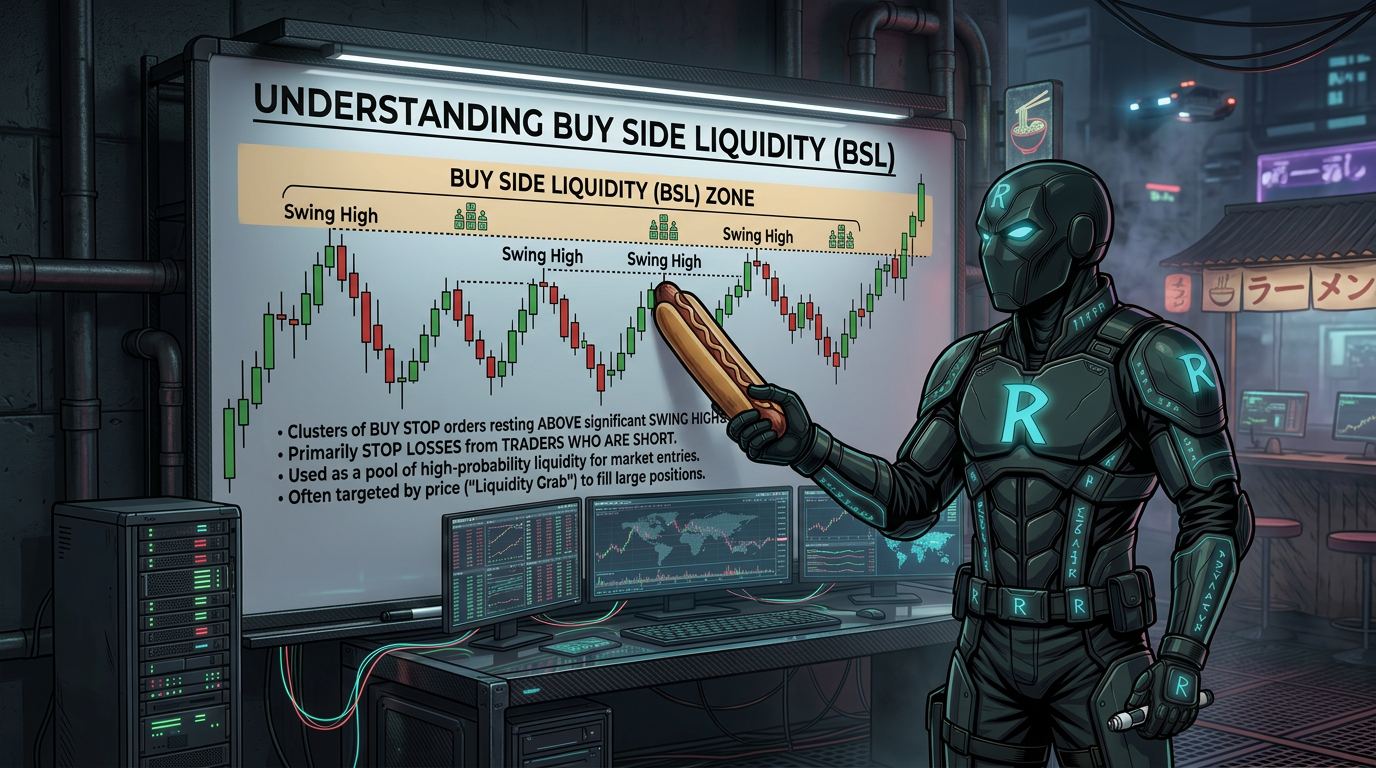
Identification Rules
- Find a swing high: a peak with a lower high on both the left and right side.
- The area just above that swing high is where buy stops are resting — this is buy side liquidity.
- Equal highs (two or more swing highs at roughly the same price) create a stronger liquidity pool.
- Old highs — single swing highs that clearly stand out — also mark buy side liquidity.
- Mark the previous week's high, previous day's high, and session highs (Asia, London, New York) as key buy side levels.
Entry Rules
- Wait for price to sweep buy side liquidity above a swing high, then look for a reaction.
- After a sweep, look for displacement (a strong, fast move) in the opposite direction.
- Use a fair value gap (FVG) created during displacement as a precise entry point.
Stop Rules
- Place your stop loss above the swing high that was swept.
- If entering on a pullback into a fair value gap, place the stop just above the top of the FVG.
Target Rules
- Target the nearest sell side liquidity below — swing lows, equal lows, or session lows.
- Use session lows (Asia, London) as natural targets when trading New York session.
- Previous day low and previous week low are strong draw targets for larger moves.
Confluence Factors
- Equal highs at the same level — more stops stacked means a stronger draw for price.
- Previous week's high aligns with a swing high on the current chart.
- Session high (Asia or London) sitting just above a swing high.
- Fair value gap near the buy side liquidity level that price may use to launch from.
- Previous day's high acting as a draw on liquidity in the same direction.
- Higher timeframe trend aligned with the move toward buy side liquidity.
Failure Modes
- Price sweeps buy side but does not reverse
- Weak displacement after the sweep
- Multiple sweeps without follow-through
Common Mistakes
- Entering short the moment price touches a swing high without waiting for confirmation.
- Ignoring session and daily highs as liquidity levels.
- Treating every swing high as equally important.
- Forgetting to update buy side levels after they are taken out.
- Confusing buy side liquidity with a buy signal.
Frequently Asked Questions
What is buy side liquidity in simple terms?
Buy side liquidity is a zone above a swing high where a lot of stop orders from short traders are sitting. Price is often pulled toward these zones so those stops get triggered. Smart money uses this process to fill their own large orders.
What is the difference between buy side and sell side liquidity?
Buy side liquidity sits above swing highs — that is where short traders place their stop losses. Sell side liquidity sits below swing lows — that is where long traders place their stops. Price moves between these pools, hunting stops on both sides.
How do I find buy side liquidity on a chart?
Look for a swing high — a candle peak that has lower highs on both sides. The area just above that high is buy side liquidity. Equal highs and old prominent highs are especially strong levels. Also mark your session highs, previous day high, and previous week high.
Does price always reverse after sweeping buy side liquidity?
No, not always. Sometimes price sweeps a high and keeps moving up, especially in a strong uptrend. Look for displacement — a sharp, fast move away from the level — before assuming a reversal is happening.
What are equal highs and why do they matter?
Equal highs are two or more swing highs at nearly the same price. They matter because more stops are stacked at that level, making it a stronger draw for price. Smart money is more likely to target a cluster of stops than a single isolated high.
What session highs should I mark on my chart?
Mark the Asia session high and low, the London session high and low, and track the New York session as it develops. Also mark the previous day's high and the previous week's high. These are common liquidity targets that price moves toward regularly.
How do I use buy side liquidity to find a trade entry?
First, wait for price to sweep above the swing high to grab buy stops. Then look for displacement — a strong move back down. After that, find a fair value gap created during the displacement and wait for price to pull back into it. That pullback is your entry area.
Where should I put my stop loss when trading a buy side liquidity sweep?
Place your stop above the swing high that was swept. If you are entering on a pullback into a fair value gap, you can tighten the stop to just above the top of that gap.