
Low Volume Node (LVN) — Pattern Reference | runic.tools
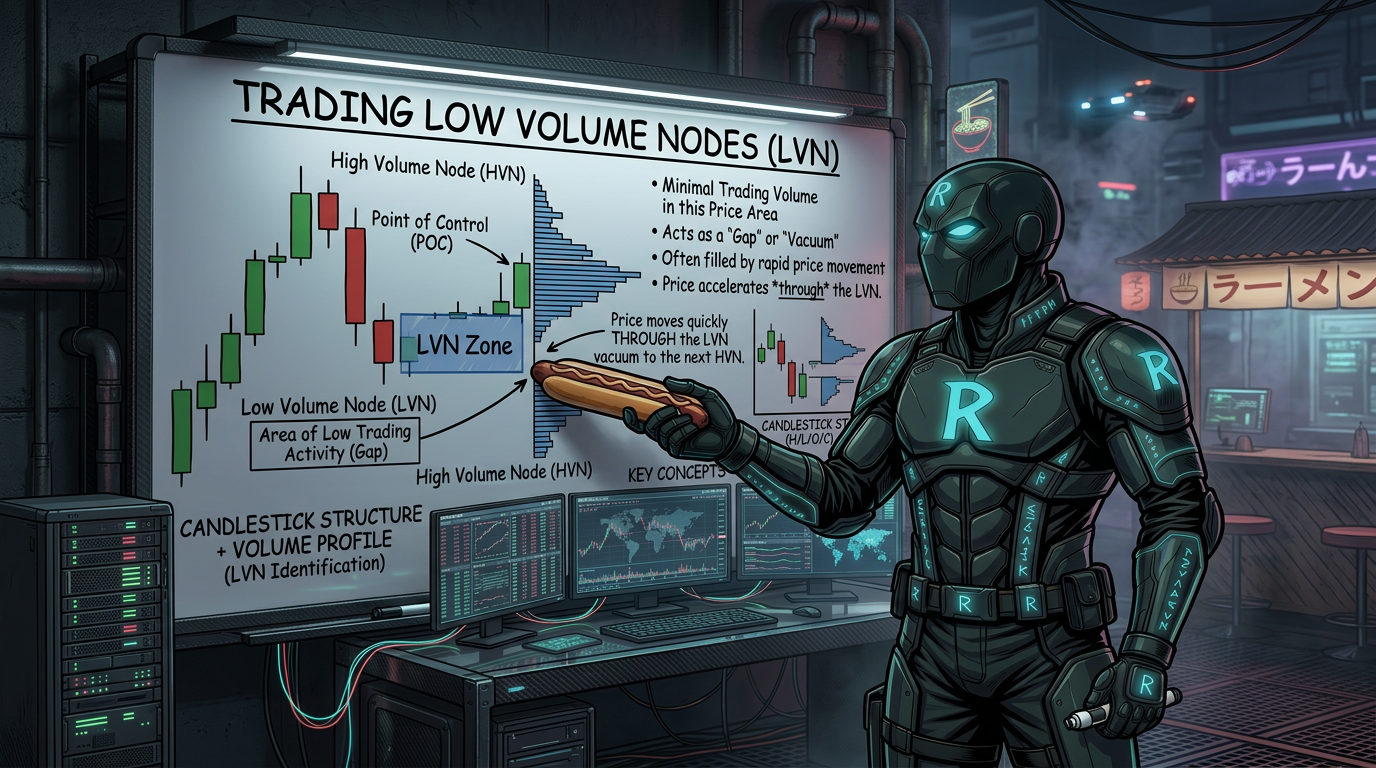
Identification Rules
- Pull up a volume profile on your chart — fixed range, session, or anchored.
- Find the tall, wide bars on the profile. These are High Volume Nodes (HVNs).
- Look at the edges of those HVNs. The thin or empty areas beside them are your LVNs.
- Mark the LVN as a zone, not just a single line. Give it some width.
- Use recent profiles. A session profile from the previous day is still useful. One from five days ago is less relevant.
- Look for price that has already reacted at the zone — resistance, then support, then resistance again. This confirms the inversion.
Entry Rules
- Go short when price rallies back into an LVN zone that previously acted as support and has since broken down.
- Go long when price pulls back into an LVN zone that previously acted as resistance and has since broken above.
- Enter at the top edge of the LVN zone for shorts or the bottom edge for longs to get the best risk-to-reward.
- Look for a breakout followed by a retest of the LVN zone, then enter in the direction of the breakout.
Stop Rules
- Place your stop loss above the LVN zone for short trades.
- Place your stop loss below the LVN zone for long trades.
- Do not use a single line as your stop reference. Use the full width of the LVN zone.
Target Rules
- Target the next significant High Volume Node below (for shorts) or above (for longs).
- On short intraday moves, even small LVN reactions can produce meaningful point gains.
- Use the Point of Control (POC) of a nearby profile as a secondary target.
Confluence Factors
- Trend alignment — LVN inversion zones work best when the trade direction matches the overall trend.
- Session gap — a gap down or up into an LVN zone at the open adds conviction.
- Structure break — price making lower highs and lower lows before retesting an LVN adds confluence for shorts.
- Multiple profile agreements — when two different volume profiles (e.g. session and fixed range) show an LVN at the same price, the zone is stronger.
- Prior reactions — an LVN that has shown resistance, then support, then resistance again has proven itself.
- Time of day — LVN reactions at the open or after lunch hours in futures markets tend to be more reliable.
Failure Modes
- Price blows straight through the LVN zone
- Zone is too old
- Profile shape changes
- Fakeout entry
Common Mistakes
- Treating the LVN as a single price line
- Ignoring the trend when trading an LVN
- Using profiles from too far back
- Entering too early before a reaction is confirmed
- Confusing HVNs and LVNs
Frequently Asked Questions
What is a Low Volume Node?
A Low Volume Node (LVN) is an area on a volume profile where very little trading took place. It shows up as a thin or empty gap between thicker volume bars. These areas often act as strong support or resistance.
How is an LVN different from a High Volume Node?
A High Volume Node (HVN) is where most of the trading happened — it shows as a wide bar on the profile. An LVN is the opposite: a thin area with very little volume. LVNs are found at the edges of HVNs.
Why does price react at Low Volume Nodes?
Because very few trades happened there, there is little agreement on value at those prices. When price moves into an LVN, it tends to either move through quickly or bounce sharply. Traders recognize these areas and often place orders there.
What does 'inversion zone' mean for an LVN?
Inversion means the zone flips its role. If an LVN was acting as support and price breaks below it, that same zone is now expected to act as resistance. This flip is the core setup traders look for.
What type of volume profile should I use to find LVNs?
You can use a fixed range, session, or anchored volume profile. For day trading, session profiles are common. The key is to use recent profiles — the previous session or two works best for intraday trades.
Does this work on all markets and time frames?
Yes. LVN inversion zones work on any market that has volume data, including futures, stocks, and crypto. They also work across time frames, from 5-minute charts to daily charts.
How wide should I draw the LVN zone?
The zone should cover the full gap between the high volume nodes on either side. Do not use a single line. Using a wider zone gives you a better sense of where price might react and helps you place stops more accurately.
What if price just pushes straight through my LVN zone?
That means the setup failed. It often happens during strong trend moves or when news drives momentum. Always use a stop loss beyond the far edge of the zone and do not chase the move.