
Power of Three (Po3) — AMD Pattern Reference | runic.tools
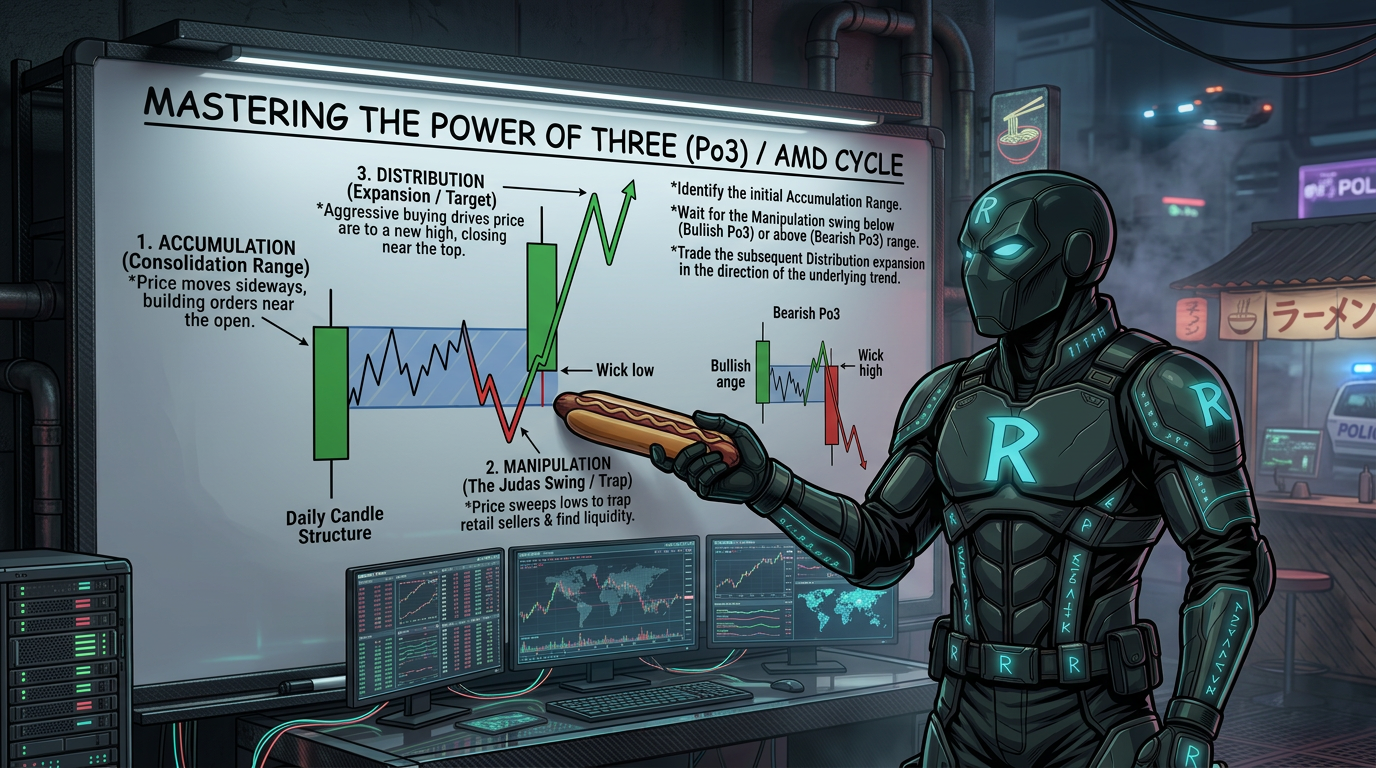
Identification Rules
- Candle 1 acts as the accumulation candle — price consolidates and builds a range.
- Candle 2 shows manipulation — a wick that runs against the expected direction before reversing.
- Candle 3 is the distribution candle — price expands in the true direction with a small wick and large body.
- If Candle 2 has a small shallow wick, manipulation and distribution can happen within the same candle.
- If Candle 2 has a large opposing run, wait for Candle 3 to open before looking for entries.
- A protected swing (change in the state of delivery) must form on the lower time frame to confirm the wick is complete.
- Align the 4-hour Po3 pattern with the daily bias before trading.
- A shallow opposing wick supports expansion. A large opposing run does not support expansion in the same candle.
Entry Rules
- Wait for the manipulation wick to fully form before entering.
- Look for a change in the state of delivery on the lower time frame to confirm the wick is done.
- If Candle 2 had a large opposing run, wait for Candle 3 to open and form its own shallow wick before entering.
- On the lower time frame, a fractal model (consolidation, sweep of a level, then change in delivery) can be used to time the entry more precisely.
- For positional entries, you can enter at the open of the new higher time frame candle with a stop on the protected swing.
Stop Rules
- Place your stop loss below the protected low (or above the protected high for shorts).
- At minimum, place the stop beyond 50% of the change-in-state-of-delivery candle.
- Do not place your stop inside the manipulation wick — it is designed to hit stops.
Target Rules
- Target the previous day's high or low as a primary objective.
- Use 2R as a minimum target to justify the trade.
- Do not extend targets beyond the current expansion candle's expected range.
- Use the -1 standard deviation as a target when a large opposing run has occurred and the range is compressed.
Confluence Factors
- Daily bias aligns with the expected distribution direction.
- Shallow opposing wick on the distribution candle supports expansion.
- Protected swing confirmed on the lower time frame.
- Fair value gap or point of interest at the wick level provides a reason for price to reverse.
- Lower time frame fractal model (consolidation, sweep, change in delivery) aligns with the 4-hour wick formation.
- EQ (equilibrium) of the previous candle's range is respected during the manipulation phase.
- SMT divergence at the manipulation low or high.
- Candle closes strongly in the direction of expansion (large body, small wick).
Failure Modes
- Expansion met with expansion
- No change in state of delivery
- Large opposing run in the distribution candle
- Trading against an active expansion candle
- Wrong daily bias
Common Mistakes
- Trying to enter during the manipulation wick instead of waiting for it to complete.
- Entering a distribution trade when Candle 2 had a large opposing run.
- Setting targets that are too far away for the current expansion candle.
- Ignoring the daily bias and trading every Po3 pattern you see.
- Holding a trade past the close of the expansion candle expecting more movement.
- Skipping the lower time frame confirmation and entering based on the higher time frame alone.
Frequently Asked Questions
What is the Power of Three in trading?
Power of Three (Po3) is a way to understand how price moves inside a candle. It has three phases: accumulation (price consolidates), manipulation (price makes a fake move to trap traders), and distribution (price moves in the real direction). The goal is to avoid the fake move and only trade the real expansion.
What time frames work best for Po3?
Po3 works on any time frame, but the 4-hour candle is a common starting point. The key is to pair the higher time frame candle with a lower time frame for entries. For example, the 4-hour pairs well with the 15-minute. The 1-hour pairs with the 3-minute or 5-minute.
How do I know when the manipulation wick is finished?
Look for a change in the state of delivery on the lower time frame. This means price sweeps a low or high, then closes back above or below it, forming what is called a protected swing. Once that forms, the wick is likely done and you can look to enter.
What is the difference between Candle 2 and Candle 3 setups?
If Candle 2 has a small shallow wick, you can trade the distribution within that same candle — this is a reversal-to-expansion setup. If Candle 2 has a large opposing run, it means the manipulation was aggressive and you should wait for Candle 3 to open before entering — this is a continuation expansion setup.
What does 'trade the body, not the wick' mean?
It means do not try to enter at the very bottom or top of the manipulation move. Trying to catch the wick gets you stopped out repeatedly. Instead, wait for the wick to fully form and confirmed, then enter as price starts moving in the real direction — the body of the candle.
Do I need a daily bias to trade Po3?
Yes. The daily bias tells you which direction price is most likely to expand. Without it, you might trade the wrong side of Po3. Always confirm the higher time frame direction before applying the Po3 framework on lower time frames.
What are the timing windows for Po3 on futures vs. forex?
For futures, the 4-hour candles open at 2 a.m., 6 a.m., 10 a.m., 2 p.m., and so on (EST). For forex, the timing windows shift slightly. The video focuses on the 6 a.m. reversal candle and the 10 a.m. continuation candle as the most common Po3 setup during the New York session.
What invalidates a Po3 setup?
A few things can invalidate it. If the distribution candle makes a large move against your direction instead of a shallow wick, it may be turning into a new manipulation. If expansion is met with more expansion in the same direction, the move is real — not manipulation. And if your daily bias was wrong, the whole structure breaks down.