
Swing Failure Pattern (SFP) — Pattern Reference | runic.tools
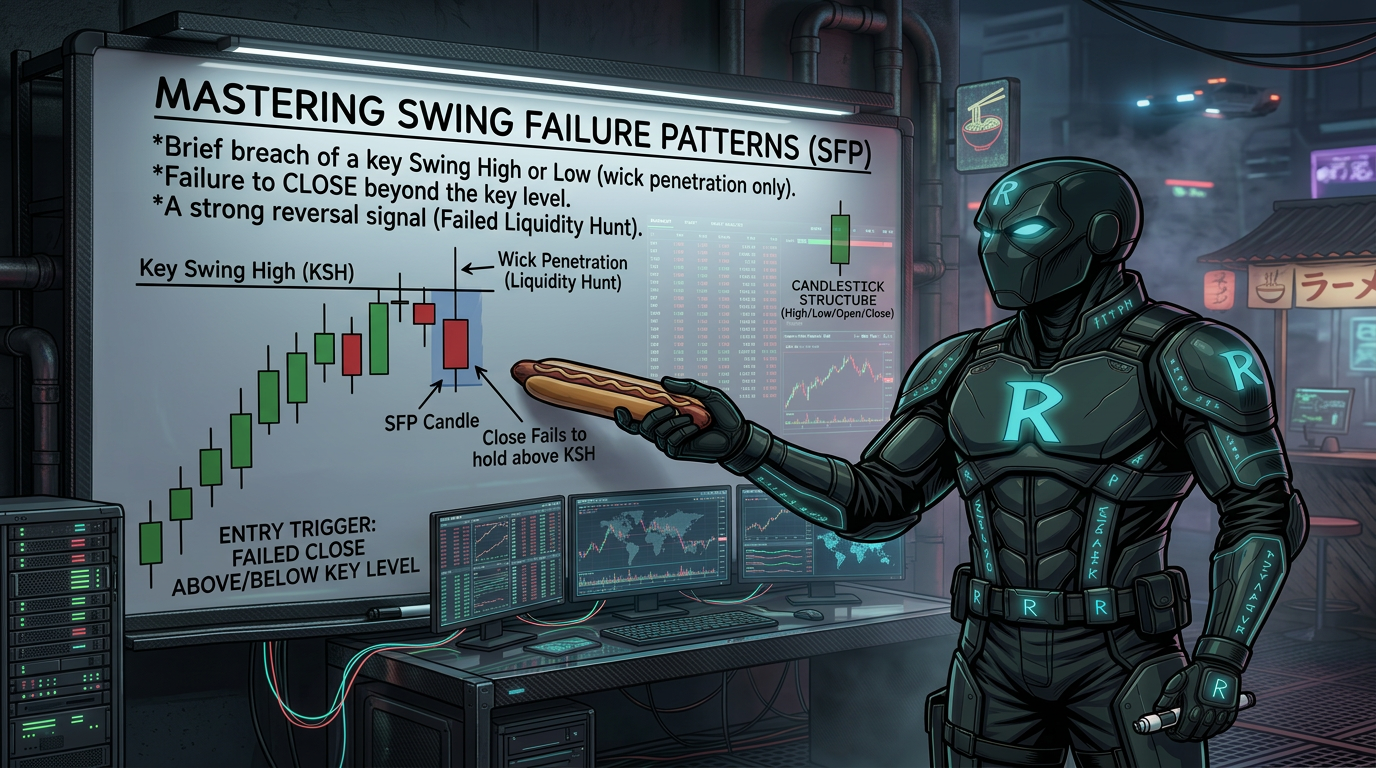
Identification Rules
- Identify a clear swing high or swing low on the chart.
- Look for a wick or brief price move that breaks beyond that swing point.
- The candle must fail to close beyond the swing level — it closes back inside the range.
- Look for relative equal highs or lows, which signal pooled liquidity and increase the chance of a sweep.
- A confirmation level (often marked as a dotted line) is broken by the next candle to confirm the reversal.
- Volume outside the swing zone should be low (under 25% of total) to confirm weak momentum in the sweep direction.
Entry Rules
- Enter after price sweeps the swing point and a confirmation candle closes back inside the range.
- For a short setup: enter after price sweeps relative equal highs and closes back below the confirmation level.
- For a long setup: enter after price sweeps relative equal lows and closes back above the confirmation level.
- Use volume validation to filter out low-quality signals.
Stop Rules
- Place your stop-loss above the wick of the swing failure pattern (for shorts) or below it (for longs).
- Do not place the stop at the exact swing high or low — go slightly beyond the wick.
Target Rules
- Aim for a risk-to-reward ratio you are comfortable with, typically 2:1 or better.
- Target the opposite side of the range or the nearest significant support/resistance level.
Confluence Factors
- Relative equal highs or lows present before the sweep — pooled liquidity makes the setup more reliable.
- Low volume during the sweep confirms weak conviction in the breakout direction.
- Pattern forms at a well-known support or resistance level or key price zone.
- Pattern aligns with the higher timeframe trend direction.
- Confirmation candle closes decisively back inside the range rather than hovering near the level.
- Pattern occurs within a clearly defined range or consolidation zone.
Failure Modes
- Price continues through the swing level after the sweep.
- Sweep without a clean confirmation close.
- Low-quality signal in choppy conditions.
- Entering too early on the wick.
Common Mistakes
- Entering on the wick before the candle closes.
- Ignoring volume when evaluating the sweep.
- Trading every SFP signal without filtering.
- Placing stops too tight at the exact swing high or low.
- Trading SFPs against a strong trend on high timeframes.
Frequently Asked Questions
What is a swing failure pattern?
A swing failure pattern happens when price briefly breaks past a key high or low but then closes back inside the range. It shows that the breakout failed and a reversal is likely.
How is a swing failure pattern different from a regular breakout?
In a real breakout, price breaks a level and closes beyond it with strength. In a swing failure, price pokes past the level but cannot close there — it snaps back, trapping traders who bought or sold the breakout.
Where do swing failure patterns happen most often?
They happen most often around relative equal highs or lows, which are areas where lots of stop orders and pending orders are sitting. The market sweeps those levels and then reverses.
What is the best way to confirm a swing failure pattern?
Wait for a candle to close back inside the range after the sweep. Some traders also use a confirmation level — when price crosses back over that line, it adds more confidence to the reversal signal.
Is there a free indicator that finds swing failure patterns automatically?
Yes. On TradingView, search for the Swing Failure Pattern indicator by Lux Algo. It highlights the pattern, adds an SFP label, and draws a confirmation level for you at no cost.
How does volume help when trading swing failure patterns?
Low volume during the sweep means there is weak conviction behind the breakout, which makes the failure more likely. If volume is high during the sweep, the move may be a real breakout instead.
Where should I put my stop-loss when trading an SFP?
Place your stop just beyond the wick that created the swing failure. For a short trade, that means above the high of the sweep wick. For a long trade, place it below the low of the sweep wick.
Can swing failure patterns work in a trending market?
Yes. In an uptrend, a swing failure on a pullback low can signal that sellers failed and buyers are stepping back in. In a downtrend, a sweep of a recent high that fails can be a good short entry. Aligning the SFP with the trend direction gives better results.