
Blew Your Prop Firm Account? Here's What to Do Next
Why Losing Streaks Are Normal
Most traders panic when they hit a losing streak. But losing streaks are a math fact, not a sign that you are broken. Even if you win 60% of your trades, there is still a 37% chance you will lose five trades in a row over just 50 trades. Over 1,000 trades, there is an 80% chance you will hit a seven-trade losing streak. That means losing several trades in a row is almost guaranteed at some point. It is not a strategy failure. It is just probability. The real danger is not the losing streak itself. The real danger is risking too much per trade so that a normal streak wipes out your account.
Risking Too Much Is the Main Account Killer
If you only have one funded account, risking more than 0.5% per trade is dangerous. Risking 1% to 3% per trade sounds small, but combine that with a normal losing streak and you can blow the account fast. The goal with a funded account is not to make a huge payout once. The goal is to make consistent payouts over and over again. Think about it this way: a blown account gives you zero payouts. A steady account with low risk keeps paying you every week. Slow and steady really does win this race.
The OAT System: Spread Your Risk Across Accounts
The OAT system means you trade multiple funded accounts at the same time but focus on one at a time. You lock in a payout on account one, then move to account two, then three, and so on. By the time you come back to account one, you have already been paid. If one account blows up, you still have income from the others. This system protects you from letting one bad week destroy everything. It also takes the pressure off any single account, which helps you trade more calmly.
Emotions Are Normal But Should Not Run the Show
Every trader feels emotions. Frustration, fear, and greed are part of being human. The problem is not that you feel emotions. The problem is when emotions drive your trading decisions. One bad trade leads to a revenge trade. That leads to another. Suddenly you are not trading your plan anymore. You are trading your feelings. This spiral is one of the most common reasons funded accounts get blown. Recognizing when you are emotional is the first step to stopping it.
The Phoenix Protocol: How to Bounce Back
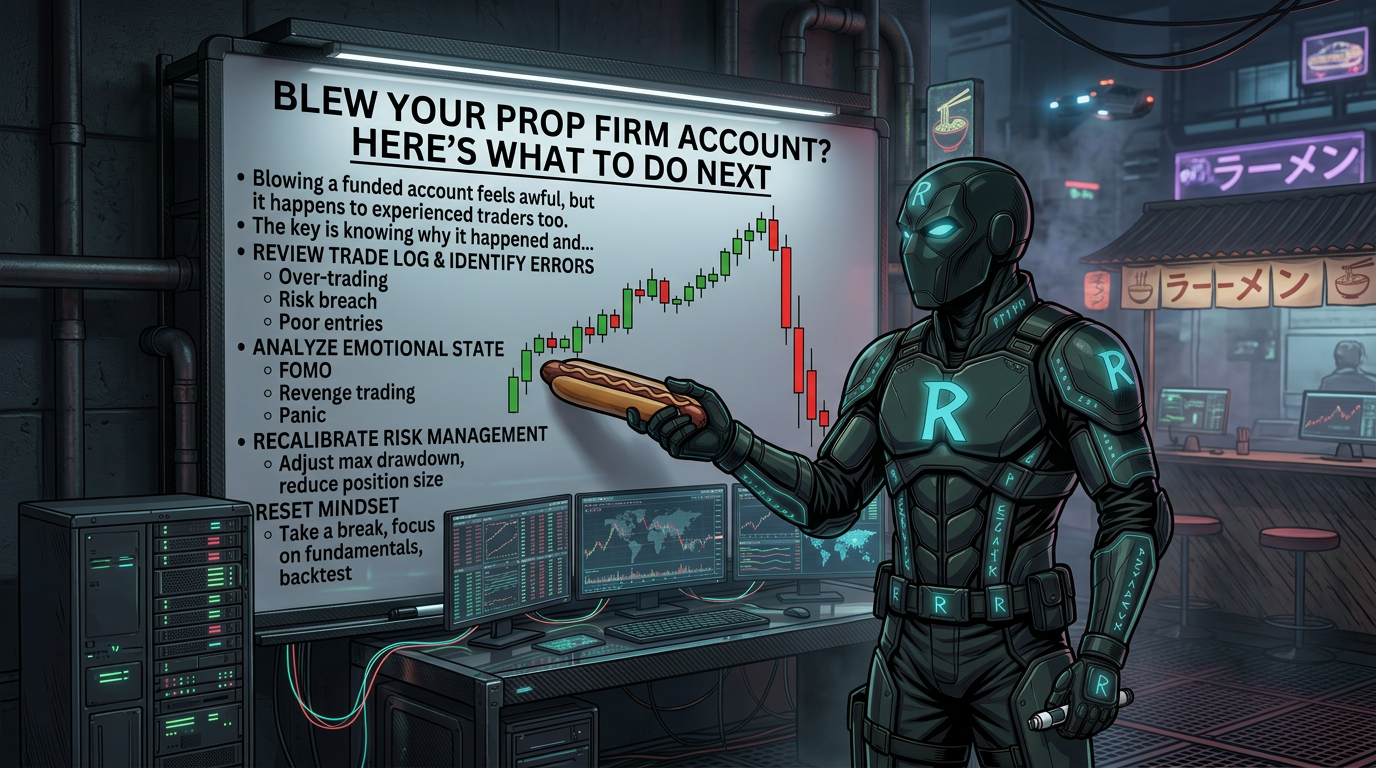
The Phoenix Protocol is a review process you run after blowing an account. It has four steps. First, go through every trade that led to the blown account. Write down every technical mistake you made. Second, write down every emotional mistake you made. Third, tag every trade that was driven by emotion, even if it was a winner. Fourth, find the one trade where the emotional spiral started. There is almost always one trade you should never have taken that kicked everything off. Once you find it, you can watch for that pattern next time and stop it early. Remove the emotional trades from your results and ask yourself if you would have been profitable without them. Most traders are shocked to find the answer is yes.
How to Adjust After Blowing an Account
One blown account is not enough data to overhaul your strategy. Do not make huge changes after a single bad run. Instead, make small adjustments. If you are losing on the one-minute chart, move up to the five-minute chart. Still losing? Move to the fifteen-minute chart. Higher time frames naturally filter out noise and give you higher probability setups. Keep your risk management the same unless you blow two or more accounts in a row. At that point, reduce risk and rebuild slowly until you are back to consistent profits.
Key Lessons From Failing
Making mistakes is normal. Repeating the same mistakes is the real problem. Every trader at every level makes errors. The difference between traders who grow and traders who stay stuck is whether they learn from those errors. Zoom out on your situation. One blown account is a tiny moment in a long career. The fear of failure usually comes from short-term thinking. When you look at the bigger picture, a blown account is just a small dip in an upward trend. The best traders have all blown accounts. What made them successful was getting up and doing the work to understand why.
Frequently Asked Questions
Is it normal to blow a prop firm account?
Yes, it happens to experienced traders too. Losing streaks are a math reality. Even with a 60% win rate, you will likely hit five or more losses in a row at some point. The key is keeping your risk low so a losing streak does not wipe out the account.
How much should I risk per trade on a funded account?
If you only have one or two funded accounts, keep risk at 0.5% or less per trade. This protects you from a normal losing streak blowing the account before you can collect consistent payouts.
What is the Phoenix Protocol?
It is a four-step review process after a blown account. You go through every trade, write down technical and emotional mistakes, tag emotional trades, and find the one trade that started the downward spiral. The goal is to learn what went wrong so you do not repeat it.
Should I change my trading strategy after blowing an account?
Not right away. One blown account is not enough data to justify a big strategy change. Instead, try moving to a higher time frame to find higher probability setups. Only make major changes if you blow two or more accounts in a short time.
How do I stop emotional trading?
First, recognize the signs. If you are frustrated or chasing a loss, stop trading immediately. Use a trade blocker or close your platform. Put distance between yourself and the charts. Then journal what triggered the emotion so you can catch it earlier next time.
What is the OAT system?
The OAT system means trading multiple funded accounts in rotation. You lock in a payout on one account, then shift focus to the next. This way, if one account blows up, you still have income from the others and do not lose everything at once.
Can I recover from a 9% drawdown on a funded account?
Yes. Many traders do. The worst thing you can do is panic and blow the account on purpose. Reduce your risk, focus on high-quality setups, and work your way back slowly. Recovering from a deep drawdown is also one of the best things you can do for your confidence.
Why do most traders blow funded accounts?
The biggest reasons are risking too much per trade, entering emotional or revenge trades, and not reviewing past mistakes. Most traders who blow accounts would have been profitable if they removed their impulsive trades from their results.