
How to Place Stop-Losses Using Protected Swings
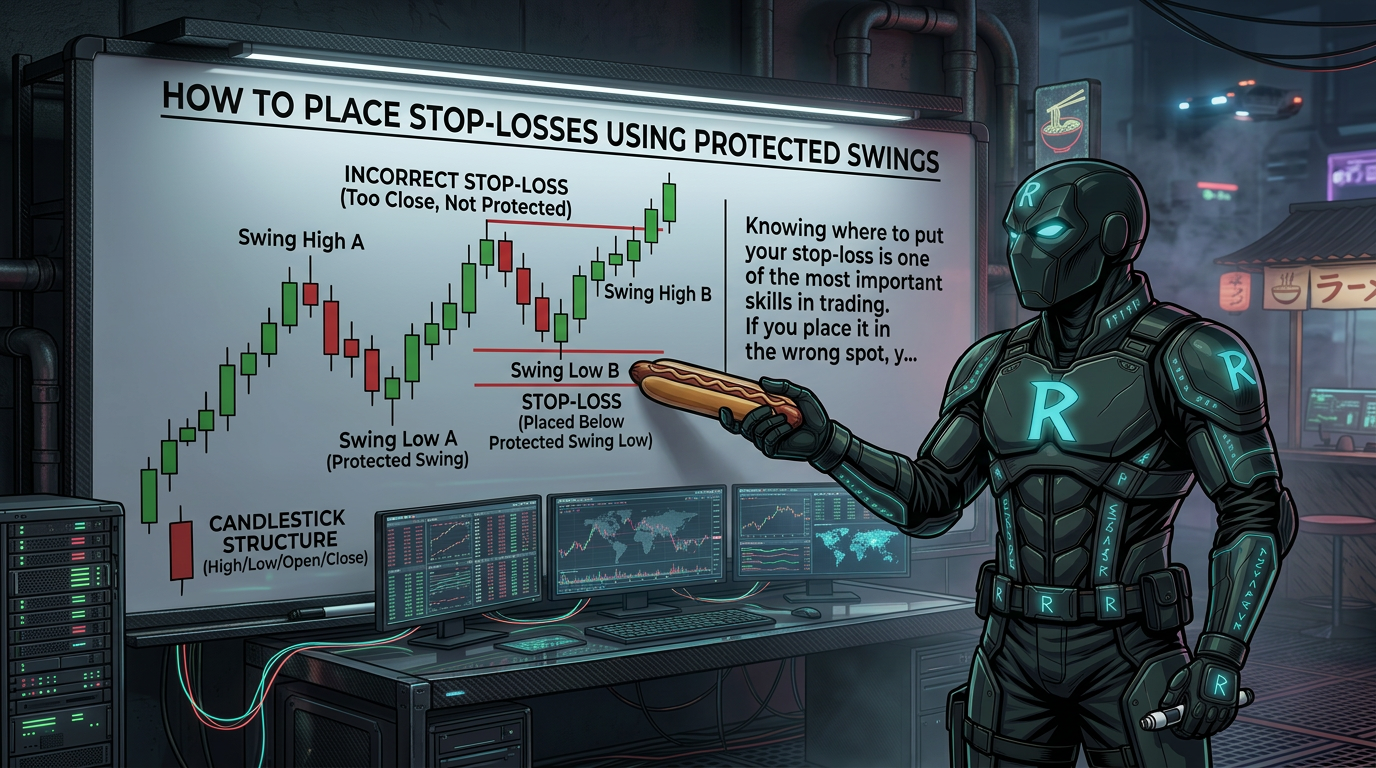
What Is a Protected Swing?
A protected swing is a price level where the market has shown real strength or weakness. It must meet two conditions to count as protected.
First, price must reach into an important level. That means it either sweeps out a prior low or trades into a fair value gap.
Second, price must then close back over the series of down-close candles that created that move. Once both conditions are met, you have a protected swing.
This protected swing becomes your anchor point. You are now expecting price to move away from it and not return.
Where to Place Your Stop-Loss
Once you have a protected swing, that is your invalidation point. If you are trading long, you expect price to go up and not return to that low.
Your stop-loss goes just below that protected low. If price breaks back through it, your trade idea is wrong.
This placement makes logical sense. You are not guessing — you are letting the market structure tell you when you are wrong.
Adjusting for Better Risk-to-Reward
Sometimes placing your stop at the full protected swing low does not give you a good risk-to-reward ratio. You might only get 1R when you want at least 2R.
In that case, you can tighten your stop to the body of the candles instead of the wick lows. This is called manipulating the stop-loss.
The tradeoff is real: a tighter stop can get you stopped out early, and then price goes on to hit your target without you. You need to accept that risk when you tighten the stop.
Only tighten your stop when the candle structure clearly shows a strong rejection. A V-shaped reversal with no return to the body is a good sign.
Reversal Entries vs. Continuation Entries
A reversal entry is taken right after a protected swing forms. It often has wider stops and lower risk-to-reward.
A continuation entry waits for a new protected swing to form in the same direction. Price must pull back into a point of interest — like a fair value gap or a swept low — and then close back over the down-close candles.
Continuation entries almost always give you better risk-to-reward. They confirm the trend is still intact and give you a tighter, more logical stop.
If you miss the reversal entry, wait. A continuation setup will often appear as price moves in your direction.
Using the 50% Level When There Is No Fair Value Gap
Sometimes price pulls back but there is no fair value gap to act as a point of interest. In this case, use the 50% level of the down-close candles.
This is called the mean threshold or T-spot. Price respecting this level shows the trend is still strong.
If price holds at the 50% level and closes back over the down-close candles, that is a valid continuation entry. You can place your stop below that new protected low.
How to Track a Trend Using Protected Swings
As a trend develops, new protected swings keep forming at higher lows (in an uptrend) or lower highs (in a downtrend). You track these as the trend progresses.
Each new protected swing becomes your updated stop-loss level. You trail your idea, not just your stop, using these new swing points.
Stop looking for entries once your target is reached. New phases of price action form at major highs and lows — that is where you reassess.
What If You Miss the Setup?
You will miss trades. That is normal and expected, even when you know where price is likely going.
Sometimes price moves without giving a clean continuation entry. There may be no fair value gap and no swept low — just a messy pullback.
In those cases, skip the trade. Forcing an entry without a proper protected swing and clear stop level is how traders blow up accounts.
Wait for the next opportunity. There will always be another trade.
Frequently Asked Questions
What is a protected swing?
A protected swing is a price level where two things happened: price reached into an important level (like a fair value gap or prior low), and then closed back over the down-close candles that caused the move. Once both conditions are met, that swing is considered protected.
Where exactly should I put my stop-loss?
Place your stop-loss just below the protected swing low for long trades, or just above the protected swing high for short trades. That is the point where your trade idea is proven wrong.
What if I can't get 2R with my stop at the wick?
You can tighten your stop to the body of the candles instead of the wick. This improves your risk-to-reward but increases the chance of being stopped out early. Only do this when the rejection is very clean and sharp.
What is a continuation entry and why is it better?
A continuation entry waits for a new protected swing to form after the initial reversal. Because price has already moved in your direction, your stop is tighter and your risk-to-reward is usually better than the original reversal entry.
What do I use as a point of interest if there is no fair value gap?
Use the 50% level (mean threshold) of the last down-close candle series. If price holds at that level and closes back over the candles, it is a valid continuation entry.
Does this stop-loss method work with other trading tools like breaker blocks or inversions?
Yes, the concept of protected swings applies to other tools too. You just need to define your own invalidation — for example, a close back above an inversion or above a fair value gap candle. The logic is the same.
What should I do if I miss the setup?
Skip the trade and wait for the next one. Do not force an entry just because you know the direction. If there is no clean protected swing with a clear stop level, there is no valid trade.
When should I stop looking for entries in a trend?
Stop taking entries once price reaches your original target. New trade opportunities form at major highs and lows, not in the middle of a move that has already played out.