
How to Tell If the Market Is Trending or Ranging
Why This Matters
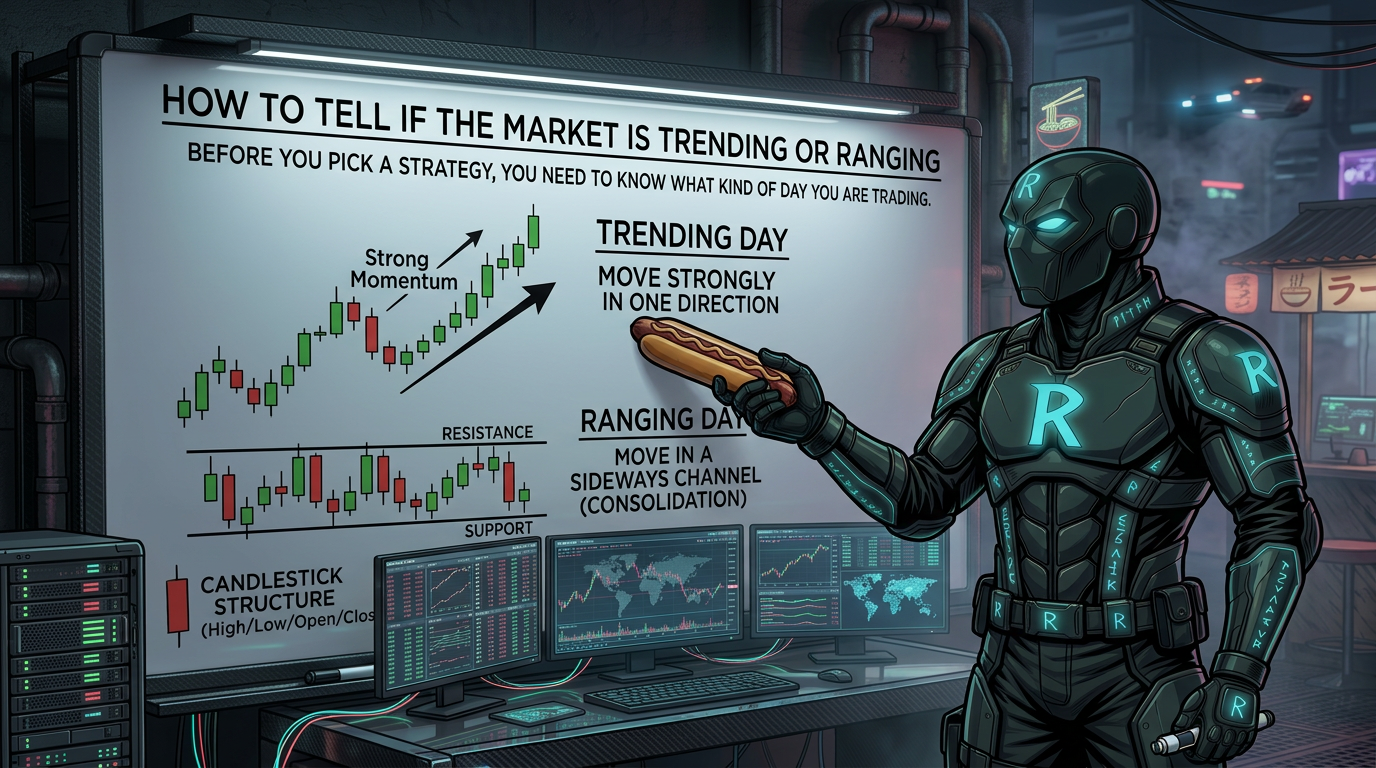
Trend strategies and range strategies are opposites. A range strategy tries to fade moves back to the middle. A trend strategy tries to ride moves in one direction. Using the wrong one on the wrong day leads to losses. The goal is to read early clues so you can decide quickly which type of day you are in.
Key Signs of a Trending Day
Here are the main clues that a trending day is developing. First, the initial balance is small. The initial balance is the range set in the first hour of active trading. A small opening range means early participants are uncertain and waiting. Second, once a direction breaks out, you see single prints on a market profile. These are fast one-way moves with little overlap. Third, after each push, the market pauses and absorbs volume. Buyers or sellers are collecting positions at better prices rather than chasing. Fourth, the market closes near the extreme high or low of the day.
The Anatomy of a Trend Move
A healthy trend does not move in a straight line. It pushes in one direction, then pauses in a small range, then pushes again. Each pause is where new participants enter in the same direction. Those small pauses are low-volume areas on the profile. As long as those areas stay unfilled, the trend is intact. When the market starts filling those low-volume zones back in, the trend is likely ending.
Key Signs of a Ranging Day
Ranging days look different from the start. The initial balance is wider than usual compared to recent days. Price breaks above the initial balance high but fails to follow through. Then it breaks below the initial balance low and also fails. Once both breakout attempts fail, you can be confident this is a ranging day. Two-way action is the core feature. There is as much buying as there is selling, and neither side can gain control.
How to Predict a Ranging Day Before It Starts
One of the best predictors of a ranging day is a volume cave on the market profile. A volume cave is a low-activity area between two high-volume zones. When the market opens in the middle of that cave, it often needs to fill it in by trading up and down between the high-volume areas. This sets up range trading naturally. Add in nearby support and resistance levels from the chart and you have a strong case for a range day before it even begins.
Trending vs Liquidation: Do Not Confuse Them
A real trend moves steadily. Participants still try to get good prices, so the move grinds higher or lower with pauses. A liquidation move is different. It is fast and sharp. It happens when trapped traders panic and exit all at once. Liquidation moves often follow a long period of range trading where energy has built up. Once the move is over, the market usually stabilizes and ranges again. It does not continue trending. Do not mistake a fast liquidation spike for the start of a new trend.
Volatility vs Trend: Know the Difference
High volatility means bigger daily ranges. But a bigger range does not mean the market is trending. During high volatility periods, a market can still bounce up and down in a range. It just does so across a much wider distance. Use the Average True Range to track how big daily moves have been lately. If ATR is high, expect range-bound days to still cover a lot of ground. Adjust your profit targets and stops to match. What feels like a trend in a low-volatility period might just be normal noise in a high-volatility period.
Use the Bigger Picture to Add Conviction
Zoom out before you zoom in. If the market has just broken above a major long-term resistance level with no obvious levels above it, conditions favor trending behavior. If the market is stuck between well-known long-term support and resistance, conditions favor ranging behavior. Always ask: how much reason do participants have to keep buying or selling from here? More room to move in one direction means more chance of a trend. Trapped between clear levels means more chance of a range.
Frequently Asked Questions
What is the fastest way to know if today will be a trend day?
Watch the first hour. A small, tight opening range is the first clue. If price then breaks out in one direction and holds, you are likely on a trend day. If the opening range is wide and breakouts keep failing, it is probably a range day.
What is the initial balance and why does it matter?
The initial balance is the price range set during the first hour of active trading. A small initial balance suggests participants are cautious and a directional move may follow. A large initial balance often means the market is already showing two-way action and may stay range bound.
Are some markets always more range bound than others?
Not really for most individual markets. The exception is spread trading, where two very similar contracts are compared. Those tend to stay within a predictable range. For a single outright market, it depends on the day and the conditions, not the market itself.
What is a liquidation move and how is it different from a trend?
A liquidation move is a fast, sharp price spike caused by panicking traders exiting bad positions all at once. A real trend is steady and grinds in one direction with pauses. Liquidation moves usually reverse or go sideways after they finish. Trends keep building.
Can I use range strategies in a volatile market?
Yes. High volatility just means the range is bigger than normal. The market can still be range bound. Just adjust your targets and stops to match the wider swings. Use the ATR to know how big daily moves have been recently.
How does a volume cave help predict a ranging day?
A volume cave is a thin area on the market profile between two high-volume zones. When price opens in the middle of that cave, it tends to fill it in by moving back and forth. This creates a natural range between the two high-volume areas, which you can trade.
How do I know when a trending day is over?
Two things signal the end of a trend. First, the market fills back into the low-volume zones it created during the trend. Second, it fails to close near the extreme of the day. When you see either of these, the trend may be losing steam.
Does the bigger picture matter when deciding between trend and range?
Yes, a lot. If price has just broken above a major long-term level with nothing obvious above it, a larger trend is more likely. If price is sandwiched between strong long-term support and resistance, a range is more likely. Always check higher timeframes before you trade.