
Why You Keep Failing Prop Firm Evals (And How to Actually Pass)
Stage 1: The Excited Beginner
When you first start trading, you're pumped up. You watch videos, follow gurus, and learn buzzwords like liquidity, risk-to-reward, and sessions. You lose some trades, win some trades, and tell yourself it's all part of the process. The problem is you can't actually explain why you took any of your trades. You're just doing what everyone on social media tells you to do. That's normal. Everyone starts here. But you can't stay here.
Stage 2: The Dangerous Early Win
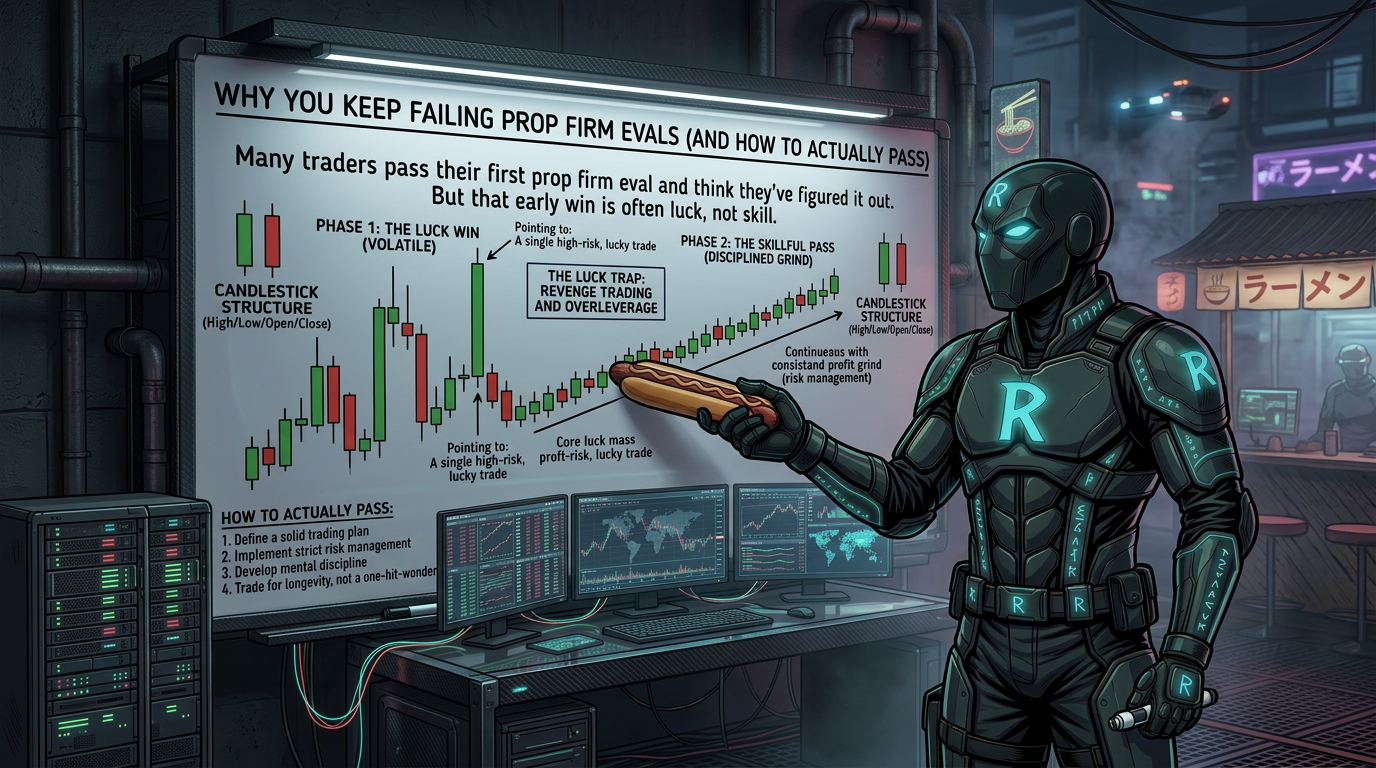
At some point you get lucky. You catch a big move. Maybe you pass a prop firm eval. You feel like you've cracked the code. You think it's skill, but it's mostly luck. Market conditions just happened to line up for you. This is the most dangerous stage. Traders who think they've made it start sizing up, taking more risk, and then they blow everything when the conditions change. The fall from here is hard.
Stage 3: Rock Bottom
After the early wins stop, losses start piling up. You don't know how to get back on track because you were never really in control. You had no real confidence because you were following someone else's rules the whole time. This rock bottom moment is actually important. It forces you to stop and ask a hard question: Do I actually understand what I'm trading, or am I just copying people? Most traders quit here. The ones who push through are the ones who eventually make it.
Stage 4: Building Your Own Eye
The turning point comes when you stop asking what other traders see and start asking what you see. Watch one market closely. Notice how it moves during specific sessions. Notice where price tends to go. Don't force strategies or fixed risk-to-reward rules onto the chart. Just observe the behavior. Do this with gold, NQ, or whatever you trade. Over time you'll start to notice patterns that you found yourself. That's when real confidence starts to build.
Stage 5: Real Profitability
Once you understand what you're seeing, everything changes. You're not trading blindly. You have a reason for every entry. When you pass a prop firm eval at this stage, it doesn't feel like luck because it isn't luck. You can repeat the process. You can scale without panic because you understand why you're profitable. This is the stage where consistent months become possible.
Learning From Others Without Copying Them
Learning from other traders is fine and even helpful. But there's a big difference between learning and copying. When you copy someone else's strategy without understanding it, you're borrowing their conviction. Borrowed conviction breaks down the moment the trade goes against you. Take pieces from traders you respect, then go to the charts and ask yourself what you see. Make the strategy yours. You need to build your own belief in your trades.
Frequently Asked Questions
How many times can you fail a prop firm eval?
Most prop firms let you buy a new eval and try again as many times as you want. But failing repeatedly is a sign the problem isn't bad luck. It usually means you don't have a clear, repeatable edge yet. Buying more evals without fixing the root cause is just throwing money away.
Is it normal to pass an eval and then blow the funded account?
Yes, and it's very common. Many traders pass their first eval during a lucky streak. When conditions change, they have no real understanding to fall back on. The funded account then gets blown because the edge was never real to begin with.
Why do I keep losing after my first big win in trading?
Early wins in trading are often driven by luck and favorable market conditions. If you can't explain exactly why your trades worked, you won't be able to repeat them. The market will shift and your results will shift with it.
Should I follow a trading guru's strategy exactly?
You can learn from them, but don't copy blindly. Take the concepts they teach, go to the charts yourself, and find examples on your own. You need to understand the idea well enough to spot it without being told. That's when it becomes useful.
How do I build real confidence as a trader?
Real confidence comes from understanding what you're seeing on the chart, not from following someone else's signals. Spend time watching one market in one session every day. Over time you'll start to recognize patterns you found yourself, and that's where genuine confidence comes from.
What does rock bottom in trading actually look like?
It doesn't always mean blowing every account. Sometimes it's the moment you realize you have no idea why you're taking trades. You've had some wins, but you can't explain them. You feel stuck and uncertain. That realization is actually the turning point if you use it to start building real knowledge.
How long does it take to become consistently profitable?
There's no fixed timeline. It depends on how quickly you move from copying others to developing your own understanding of the market. Some people rush through evals for months and never get there. Others slow down, study one market closely, and find their edge faster because of it.
What is the best way to study the market on my own?
Pick one instrument like gold or NQ. Watch it during the same session every day. Don't trade, just observe where price moves and how it behaves at key levels. Write down what you notice. After a few weeks you'll start to see tendencies that you can build a real strategy around.