
What Time Should You Trade Futures? (And When to Stop)
Why Intraday Gets All the Attention
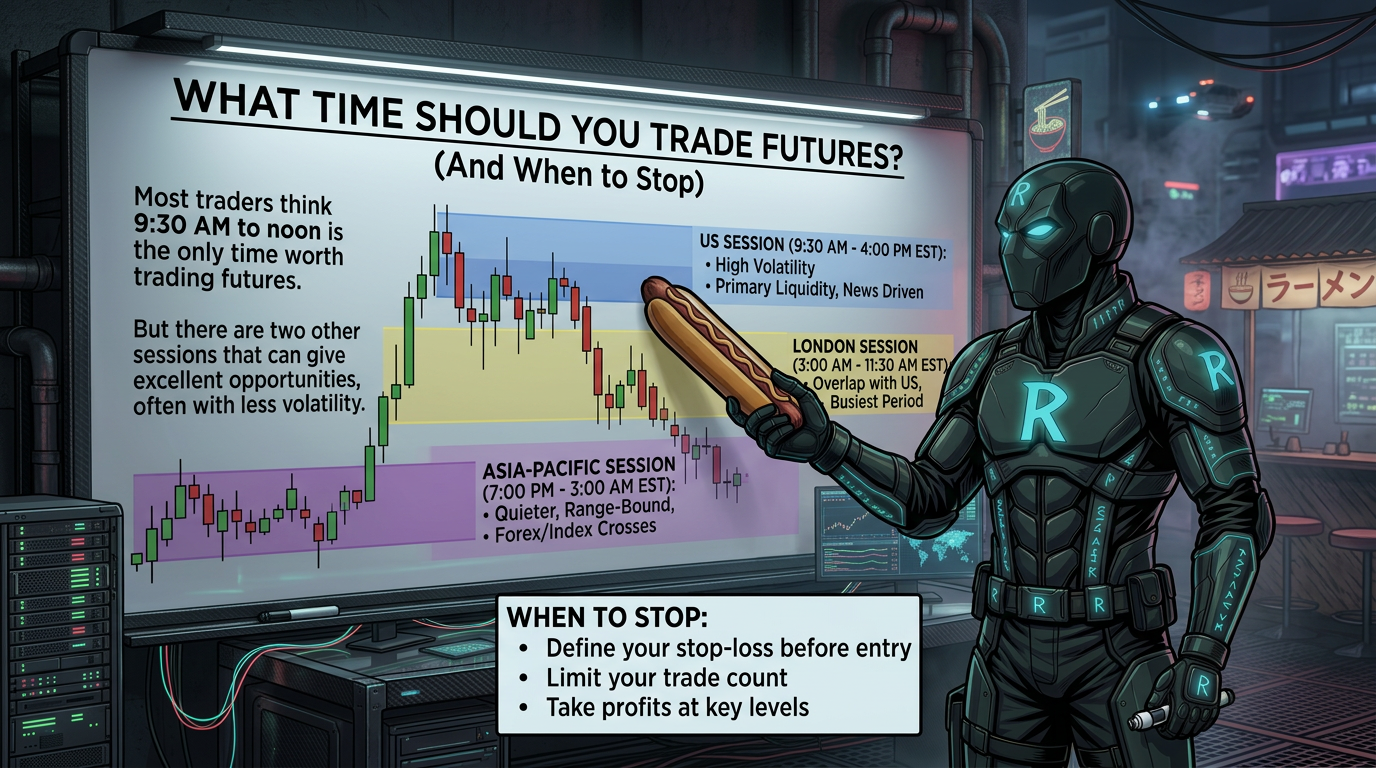
The intraday session runs from 9:30 AM to 4:00 PM Eastern. It has the most volume and the most contracts being traded. If you are a scalper going for one or two points, this is your window. It is fast, active, and full of movement.
But there is a catch. Most retail traders only trade intraday because the margin is low. You only need $500 to trade one contract during this window. Outside of intraday hours, you need $16,000 or more. That price locks most people out of other sessions.
How Prop Firms Open Up New Sessions
A prop firm gives you a funded account. Common sizes are $25K, $50K, or $100K. With that kind of capital, you can meet the margin needed for overnight trading.
This changes everything. You are no longer stuck with just the intraday window. You can trade the overnight session and the end-of-day session. Both of these can give you 20 to 90 point runs with the right setup.
The Overnight Session (Ranked #2)
The overnight session starts after the regular market closes and runs until the next morning. Candles move slowly, but they can have big explosions in price.
Here is the strategy: use the prior day's price action to decide your trade direction. If the market was trending down all day and then broke that trend, you might expect another leg down. You enter at night and let the trade run.
One example from the video showed a 90-point drop that started overnight and ran all day. At three contracts, that is $13,500 from a single trade. Another example showed a 37-point move and a 20-point move from clean overnight setups.
Because the candles move slowly at first, you can often get out of risk before you go to sleep. That means you wake up to a trade already in profit.
The End-of-Day Session (Ranked #1)
The end-of-day window runs from about 2:00 PM to 4:00 PM Eastern. This is the top-ranked session for price action traders.
Here is why it works so well. By 2:00 PM, you have a full day of price action to read. You can see the trend, the trend breaks, the highs, the lows. You do not have to guess what the market might do. You can see what it already did.
Around 2:00 to 2:30 PM, big banks and smart money start taking profits. When they do, the market often reverses or continues in a clean direction. This creates 20 to 30 point runs in the last hour or two of the day.
Because the top or bottom of a move has already been confirmed by that time, you can use a very small stop. Two to three points is often enough. That gives you a great risk-to-reward ratio on a 10 to 30 point target.
Examples from the video showed a 25-point drop, an 11-point continuation trade, and a 10-point short from a triple top, all entered between 2:00 and 3:30 PM.
The Final Ranking: Which Session Is Best for You
Here is how the sessions rank for a price action swing trader:
- End of Day — Most price action to read. Small stops. Big reward potential. Best for one focused trade.
- Overnight — Use prior day action to find direction. Slow start but can run huge. Great if you work a 9-to-5 job.
- Intraday — Most volume. Best for scalpers. Harder to read at the open because you have limited price action.
If you are scalping, intraday is still great. But if you want bigger moves with more confidence, end of day and overnight are worth learning.
Frequently Asked Questions
Is 9:30 AM to noon really the best time to trade futures?
It depends on your style. Scalpers going for one or two points do well during this window because there is a lot of volume. But for price action traders looking for bigger moves, the end-of-day and overnight sessions can actually work better.
What is the end-of-day session and when does it start?
The end-of-day session is roughly 2:00 PM to 4:00 PM Eastern. By this time you have a full day of price action to read. Big institutions start taking profits around this time, which often creates clean 20 to 30 point moves.
Can I trade the overnight session if I work a day job?
Yes, that is actually one of the best reasons to try it. You use the prior day's chart to find a setup, enter before bed, and let the trade run overnight. Some trades move 30 to 90 points by the next morning.
Why do I need a prop firm to trade overnight futures?
The overnight margin requirement is around $16,000 per contract. Most retail traders do not have that sitting in their account. A prop firm gives you a funded account large enough to meet that margin, so you can trade outside of intraday hours.
How big of a stop loss do I need for end-of-day trades?
Because the high or low of the day is already confirmed, you can often use a very small stop — sometimes just two or three points. This makes the risk-to-reward ratio very favorable when targeting a 10 to 30 point move.
What is the risk with overnight trading?
Overnight candles move slowly but can spike suddenly. The good news is that if you are right about the direction, you can often lock in profit or get out of risk before you go to sleep. Just make sure your stop is set before you walk away.
Do I need to trade all three sessions?
No. The video recommends picking the session that fits your schedule and skill level. Many traders do well focusing on just one session. Start with end-of-day if you want the most price action to work with.
What market does this apply to?
The video focuses on the ES Mini futures contract, which tracks the S&P 500. The session timing and price action concepts apply broadly to other futures markets as well.