
How to Use the Economic Calendar With Your Weekly Trading Profile
Why the Economic Calendar Matters
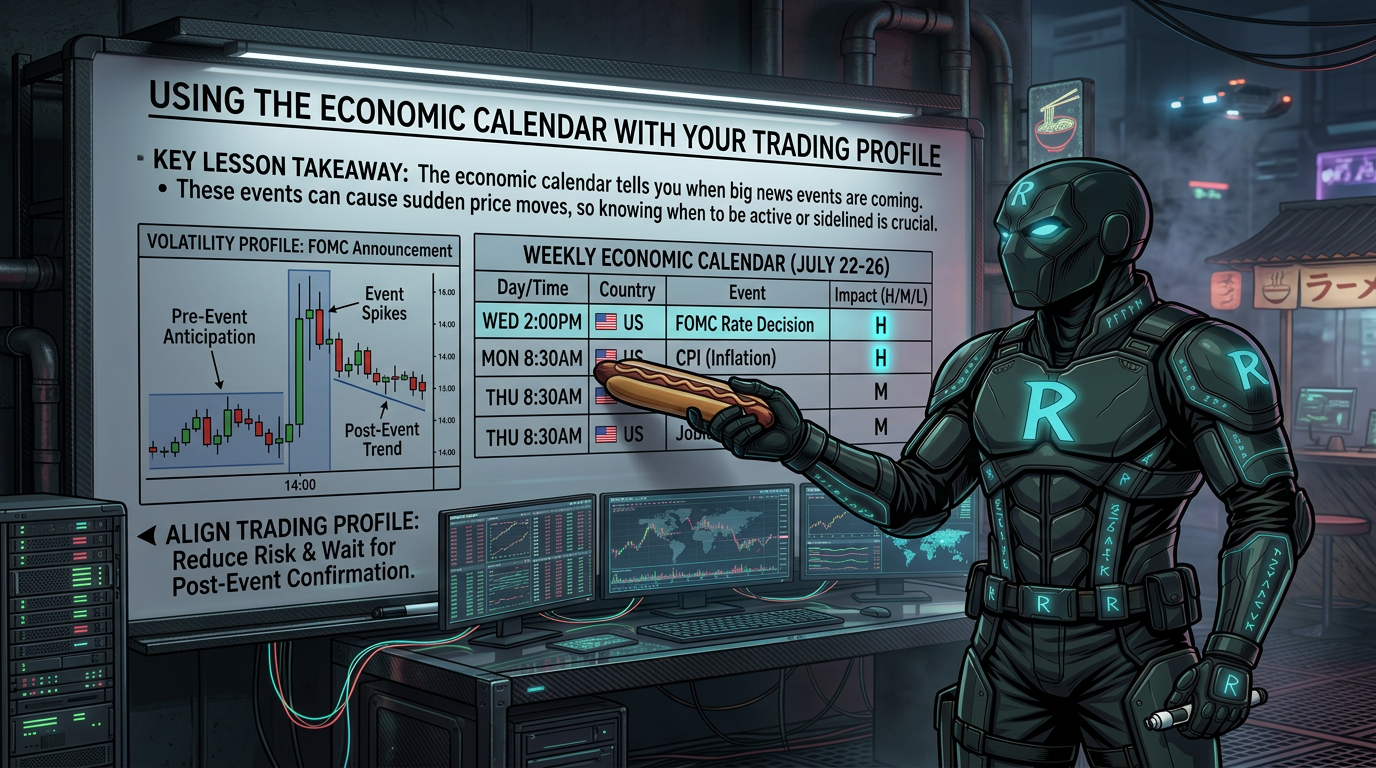
News events create volatility. Volatility can move price fast and hard, which makes trading risky if you are not prepared.
Every asset has its own news schedule. For example, NASDAQ and S&P futures are tied to US Dollar news events. AUD/CAD is tied to Australian Dollar and Canadian Dollar news.
Knowing which events affect your asset helps you plan when to trade and when to stay out.
How to Filter the Calendar on Forex Factory
Go to forexfactory.com and click on Calendar. Then click Filter.
By default, everything is selected. Deselect all currencies except the one that matches your asset. If you trade NASDAQ or S&P futures, select USD only.
Then filter to show only high impact news, shown by the red folder icon. This cuts out the noise and shows only what matters most.
Sorting News Into Three Impact Levels
Once you have your filtered calendar, sort events into three groups: high impact, medium impact, and low impact.
High impact events get the most caution. Avoid the full day before the release, skip the release itself, and only watch after it prints.
Medium impact events need less caution. Avoid the trading session before the release, skip the release, then watch after. Low impact events have no restrictions.
The Two General Rules to Start Every Week
Rule one: avoid trading on Mondays. Monday is typically the accumulation phase of the weekly profile, where price sets up for the rest of the week.
Rule two: avoid trading before the first high impact news event of the week. You do not know which direction price will move until after the release.
These two rules alone will keep you out of many low quality setups.
NFP Protocol
Non-Farm Payroll, or NFP, is one of the highest impact news events. It releases on Friday mornings.
For NFP weeks, your main focus is Friday after the release. You can also watch Tuesday and Wednesday for setups.
Avoid Thursday entirely because it is the day before NFP, which counts as high impact. This is called the NFP protocol.
Chart Example One: NASDAQ With FOMC and NFP
In this example, the week had both an FOMC release and an NFP release. Following the rules, Monday was skipped and Tuesday was skipped because FOMC was on Wednesday.
After FOMC released, price took out the low of the range. This looked like manipulation before a move higher, known as accumulation, manipulation, then distribution.
Thursday was skipped because NFP was on Friday. After NFP released, price moved down first, then reversed higher to hit the fourth standard deviation target. The weekly profile played out cleanly: accumulation, manipulation, distribution.
Chart Example Two: Core PCE Setup
This week had no high or medium impact news until Thursday with Core PCE. That made Thursday post-release and Friday the main trading days to watch.
Price had already swept a low and expanded higher earlier in the week. Large range candles usually lead to smaller range candles, so a consolidation was expected.
On Thursday, price swept the low and closed back above it. That was the change in state of delivery. Friday showed continuation higher, hitting the propulsion block and reaching the weekly max expansion target.
Chart Example Three: AUD/CAD With CPI
For AUD/CAD, you filter Forex Factory for both the Australian Dollar and the Canadian Dollar. This week had CPI on Tuesday, which is a high impact event.
The plan was simple: avoid Monday, then watch Tuesday after CPI releases. Price had already swept external lows and there was internal liquidity plus stacked previous day highs above.
After CPI on Tuesday, London session showed a series of down-close candles that were then closed above. That confirmed the change in state of delivery. Price was then targeted to the fair value gap for roughly 2R. The trade played out to the drawn liquidity.
Putting It All Together: Planning Your Week
At the start of each week, open Forex Factory and filter for your asset's currency. Identify all high and medium impact events. Mark your no-trade days based on the rules.
Once you know your trading windows, use price action from earlier in the week to define the weekly profile. Look for accumulation, then manipulation, then distribution.
Use tools like standard deviation projections, order blocks, fair value gaps, and liquidity levels to find entries and set targets. Let the news do the work of confirming direction.
Frequently Asked Questions
Why should I avoid trading on Mondays?
Monday is usually the accumulation phase of the weekly profile. Price is still setting up for the week ahead, so there is not enough information yet to find a reliable trade. Skipping Monday helps you avoid low-quality setups.
What is the difference between high, medium, and low impact news?
High impact news can move markets a lot and requires the most caution. You avoid the full day before and the release itself. Medium impact news is less extreme, so you only avoid the session before the release. Low impact news has no restrictions.
How do I find news events for currency pairs like AUD/CAD?
On Forex Factory, filter the calendar for both currencies in the pair. For AUD/CAD, select both the Australian Dollar and the Canadian Dollar. Apply the same impact rules to any events that appear for either currency.
What is the NFP protocol?
NFP, or Non-Farm Payroll, releases on Friday. The protocol is to focus mainly on Friday after the release. You can also watch Tuesday and Wednesday. Avoid Thursday because it is the day before a high impact event.
What website should I use for the economic calendar?
Forex Factory at forexfactory.com is the recommended site. Go to the Calendar section, click Filter, select your currency, and choose only the red folder or high impact events.
What is a midweek reversal and how does the calendar help me spot it?
A midweek reversal is when price makes a low or high in the middle of the week, usually Wednesday, and then reverses direction. The calendar helps because news events like FOMC often cause that reversal. Knowing the event is on Wednesday helps you expect a possible turning point.
Can I trade on the day a news event releases?
For high and medium impact events, you should avoid the moment of the release itself. Wait for the candle to print and for price to show a clear reaction. Then you can look for setups based on what price does after the news.
How do I use standard deviation projections with the calendar?
Once you identify the manipulation move for the week, you can project standard deviations from the low to the high of that move. Common targets are the second and fourth standard deviation levels. The calendar helps you know which days to watch for price to reach those targets.