
What Does It Mean When Price Sweeps a Low?
What Is Liquidity?
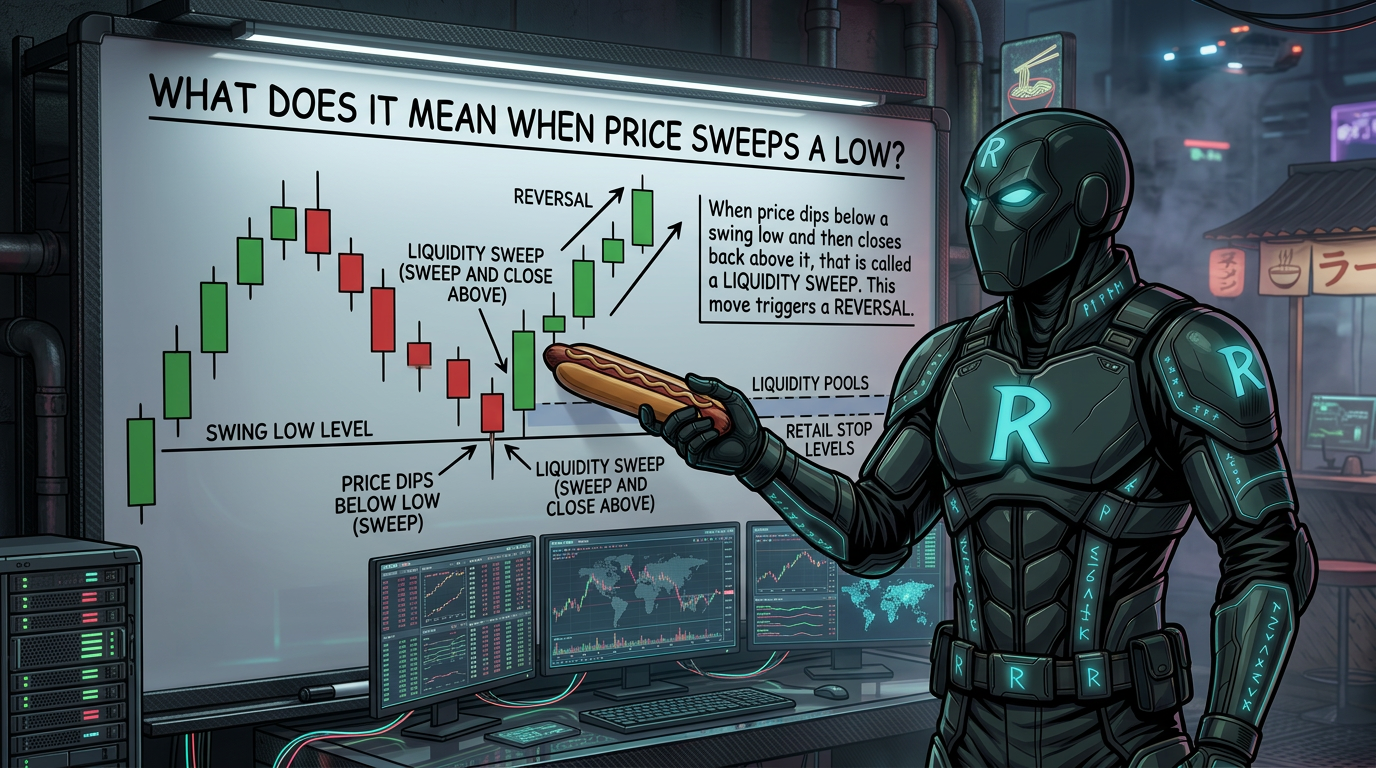
Liquidity is just a cluster of resting orders sitting at obvious price levels. These levels include swing highs and swing lows. Traders place stop losses and pending orders near these points. That creates a pool of orders the market can run into. There are three types of traders near every swing low: (1) Longs protecting their position with a sell stop below the low. (2) Breakout sellers who place a sell stop hoping price breaks lower. (3) Counter-trend buyers who place a buy limit below the low hoping for a bounce. All three groups are parked near the same level. That is your liquidity pool.
What Happens When Price Sweeps a Low?
When price dips below a swing low, several things happen at once. Long traders get stopped out at a loss. Breakout sellers enter short but immediately get trapped when price reverses. Buy limit orders from counter-trend traders get filled. After all those orders are triggered, the order book below that level dries up. With no more sell pressure, price has room to move higher. The old low is now protected because the orders that were resting there are gone.
The Swing Failure Pattern (SFP)
A swing failure pattern is the confirmation you need before entering a trade. For a bullish SFP: price breaks below a swing low but closes back above it on the same candle. That close above the low is your signal that the sweep is valid. For a bearish SFP: price breaks above a swing high but closes back below it. The close below the high is your signal. The candle close is everything. Without it, you are just guessing.
Why Most Traders Get This Wrong
The most common mistake is entering the moment price sweeps a level. Traders try to catch the exact bottom or top. This is called top and bottom ticking the market. The problem is you have no safe place to put your stop loss. You are just guessing at the turn. Instead, wait for the candle to close above the swept low. That close gives you confirmation and a logical stop loss location below the recent low.
How to Find an Entry After an SFP
Once you see a confirmed SFP on a higher time frame like the 4-hour or daily chart, drop down to a lower time frame to find your entry. Look for displacement, which means a strong impulsive move away from the swept level. Fair value gaps on the lower time frame are a good entry tool. Wait for price to trade into a fair value gap and reject it. Place your stop loss below the most recent low. Target the nearest swing high because that is where resting buy stops will be.
Real Trade Example
On a Friday morning, the ES futures market swept a major swing low on the 4-hour chart. That created a bullish SFP. On the 1-hour chart, there was also a bullish fair value gap nearby. Price traded into that gap and rejected it. The entry was taken long after the rejection candle formed. The stop was placed below the recent low. The target was the most recent swing high. The trade worked and was closed manually before a 10am news event to protect profits.
When Does This Not Work?
Liquidity sweeps and SFPs do not work every single time. Sometimes price sweeps a level, closes back above it, then comes back and sweeps it again before reversing. Other times the follow-through lasts only one candle. The pattern is a high-probability signal, not a guarantee. The key is staying consistent with your trade idea. If you get stopped out but the SFP is still valid, the next entry in the same direction is often the one that runs.
Frequently Asked Questions
What does it mean when price sweeps a low?
It means price dipped below a recent swing low to trigger resting orders like stop losses and pending entries. This is called a liquidity sweep. After those orders are filled, price often reverses back above the low.
How do I know if a liquidity sweep is valid?
Wait for the candle to close back above the swept low. If the candle wicks below the low but closes above it, that is a swing failure pattern and confirms the sweep. A close back above the level is the key signal.
Should I enter as soon as price sweeps a low?
No. Entering immediately is one of the most common mistakes. You have no safe place for a stop loss and you are guessing at the bottom. Always wait for the candle to close above the low before considering an entry.
What is a swing failure pattern?
A swing failure pattern is when price breaks beyond a swing high or low but then closes back on the other side of that level. A bullish swing failure pattern happens when price dips below a swing low but closes above it. A bearish one happens when price spikes above a swing high but closes below it.
What orders are sitting below a swing low?
There are sell stops from traders who are long and protecting themselves. There are also sell stops from breakout traders trying to short a breakdown. And there are buy limit orders from traders hoping to buy at a discount. All three groups cluster near the same level.
Where do I put my stop loss after a liquidity sweep entry?
Place your stop loss below the most recent swing low. After a valid bullish SFP, that low should be protected because the resting orders there have already been triggered and cleared out.
What is a fair value gap and how does it help?
A fair value gap is a price imbalance left behind when price moves quickly in one direction. After a bullish SFP, you can drop to a lower time frame and look for a fair value gap as an entry point. Wait for price to trade into the gap and reject it before entering.
Does this strategy work on all time frames?
Yes. Swing failure patterns and liquidity sweeps appear on all time frames from the 1-minute chart to the daily chart. Many traders use a higher time frame like the 4-hour to identify the SFP and then drop to a lower time frame like the 1-hour to find a precise entry.