
Why You Break Your Trading Rules (And How 20 Trades Can Fix It)
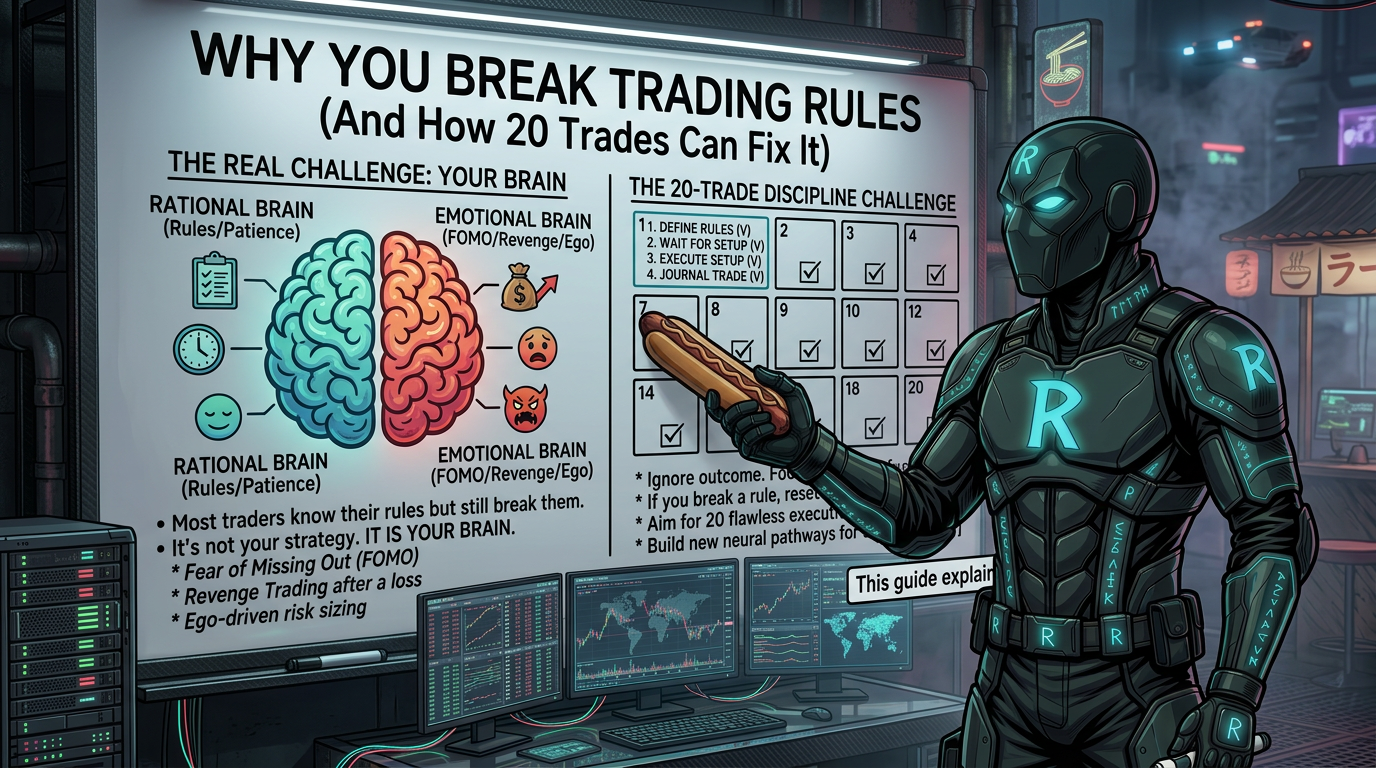
Your Brain Learns From Repetition, Not Reading
You can read every trading book and still break your rules. That is because understanding happens in your thinking brain, but trading decisions happen in your emotional brain. Your emotional brain does not respond to logic. It responds to repeated actions. Every time you follow your rule instead of your impulse, you build a stronger mental habit. Every time you skip it, you reinforce the bad habit. Think of it like a path through tall grass. The more you walk the same path, the clearer it gets. Your first 20 consistent trades are not about making money. They are about building that path.
The Pain You Feel Is Progress, Not a Warning Sign
When you start following your rules strictly, it feels wrong. You may feel anxious, doubtful, or sick before entering a trade. Most traders think this means the strategy is broken or they are not cut out for trading. They quit and start over. But that discomfort is your brain resisting change. It is normal. It is actually proof you are on the right track. The feeling of wrongness fades after enough repetitions. Do not interpret pain as failure. Interpret it as your brain fighting the rewire. Push through it.
The Death Loop: Why Switching Strategies Keeps You Stuck
Most traders have thousands of total trades but never 20 in a row with the same system. They switch strategies after a few losses or when something new looks better. This resets the counter every time. Without 20 consecutive consistent trades, your brain never finishes rewiring. You stay stuck in what feels like a permanent beginner phase. The strategy does not matter as much as you think. What matters is sticking to one long enough for your brain to adapt. No system feels right until your brain gets used to it.
Trading Can Feel Like an Addiction Without Rules
Some traders realize that once they follow a strict system, trading becomes boring. That boredom can feel like a problem, but it is actually the goal. If trading feels exciting and thrilling, you may be feeding a gambling habit rather than running a business. Real rule-based trading removes the unknowns. You know your entry, your stop, your target, and your risk before you click. That clarity kills the thrill. The good news is you can find a new kind of enjoyment in the discipline itself, in winning the battle against your own impulses every single day.
After 20 Trades, Emotions Lose Their Power
After 20 consistent executions, something changes. Wins stop feeling like a rush. Losses stop feeling like failure. You check your profit and loss and feel nothing dramatic. This is not burnout. This is mastery. Your brain has stopped treating each trade as a life or death event. Emotions still show up, but they no longer make decisions. Fear might whisper before you enter, but your process decides, not the fear. Emotions become passengers, not drivers. That shift is what separates consistent traders from emotional ones.
Losses Become a Business Cost, Not a Personal Failure
Before the rewire, a loss feels like the market punishing you. It feels personal. After 20 consistent trades, your brain reclassifies losses as the cost of doing business. You do not get angry when you pay rent. You do not panic when you buy supplies for your business. A stop-loss is the same thing. It is the price you agreed to pay to find out if the trade would work. When loss stops being emotional, you stop holding losers too long. You cut fast and move on. That speed saves money.
Pattern Recognition Becomes Automatic With Repetition
When you first learned to read, you sounded out every letter. Now you see a word and understand it instantly. Trading works the same way. Your first few trades require slow, careful analysis. After 20 consistent repetitions, your brain encodes the pattern. You look at the chart and just know if the setup is there. No more second-guessing. No more checking every condition three times. This speed and clarity come purely from repetition. You cannot think your way to it. You have to trade your way to it.
Execution Beats Strategy Every Time
A mediocre strategy executed perfectly beats a perfect strategy executed poorly. This is proven repeatedly. Traders who spend years optimizing systems but cannot follow them make less money than traders with simple average systems they execute flawlessly every time. The edge is not the system. The edge is your ability to run the system without deviation. That ability is built through repetition. Stop searching for a better strategy and start executing the one you have. Twenty trades. No exceptions.
Frequently Asked Questions
Why do I know my trading rules but still break them?
Knowing a rule and doing it involve different parts of your brain. You understand rules with your thinking brain, but you act from your emotional brain. The emotional brain only changes through repeated action, not through reading or understanding. You have to do the rule over and over until it becomes automatic.
Why does following my rules feel so wrong at first?
Your brain hates change and resists it. When you force new behavior, it creates feelings of anxiety and doubt. That discomfort is normal. It is your brain fighting the rewire. It does not mean the strategy is bad. It means you are on the right track. The feeling fades after enough repetitions.
Why is 20 trades the number?
20 is not a magic number. It is the minimum number of consistent repetitions needed for your brain to start forming a new automatic habit. Think of it as the floor, not the ceiling. After 20, the discipline starts to feel normal instead of like a constant fight.
What counts as a consistent trade?
A consistent trade means you followed every single rule in your trading plan with no exceptions. That includes your entry criteria, position size, stop-loss placement, and exit rules. A winning trade where you broke a rule does not count. A losing trade where you followed every rule does count.
What if I lose money during the 20 trades?
Losses are expected. The goal of the 20 trades is not to make money. It is to execute your process correctly. A loss where you followed your rules is a success for this exercise. A win where you broke your rules is a failure. Focus on execution, not outcomes.
Is it bad if trading feels boring after I build discipline?
No. Boring is actually the goal. If trading feels exciting and unpredictable, you may be chasing a thrill rather than running a business. When it feels boring, it means your process is working and your emotions are no longer in charge. Boring and profitable is the target.
What if I break a rule during my 20 trades? Do I start over?
Yes. The 20 trades must be consecutive with no deviations. If you break a rule on trade 14, you start back at trade 1. This sounds harsh but it is the point. Every deviation resets the wiring process. Treating each rule break as a reset keeps you accountable.
How do I stop jumping between strategies?
Pick one strategy and commit to it for a set number of trades before evaluating it. Do not judge the strategy during the 20 trades. Many traders quit systems during drawdowns that were actually normal. Your brain will tell you to switch because it wants the discomfort to stop. Do not listen. Finish the 20 trades first.