
How to Trade Fair Value Gaps Step by Step
What Is Liquidity?
Liquidity is where resting orders sit in the market. Think of stop losses, limit buy orders, and limit sell orders. Large institutions need big opposing orders to enter or exit trades. So price moves toward areas where lots of orders are clustered. Liquidity is the fuel that drives price movement. Without it, price has no reason to move.
Session Liquidity Explained
Each major trading session creates its own liquidity pool. The Asian session runs from 8:00 PM to 12:00 AM Eastern. London runs from 2:00 AM to 5:00 AM Eastern. New York runs from 8:00 AM to 12:00 PM Eastern. For stock index markets, use 9:30 AM as your New York start time. Traders place orders above session highs and below session lows during each session. Those clusters become targets for price in the next session. You will often see Asian highs taken by London, and London highs taken by New York. This is not random. Price is moving from one liquidity pool to the next.
How Institutions Use Liquidity
Most retail traders lose money. Institutions make money by being the other side of losing trades. When retail traders place stop losses below the Asian range low, institutions want to buy at exactly that level. They are buying the stop losses that retail traders trigger. If you are bullish, look for a sweep below the Asian or London range low. That sweep is institutions collecting their long positions. The same works in reverse. If you are bearish, look for a raid above the Asian or London range high. That raid is where institutions collect short positions.
What Is a Fair Value Gap?
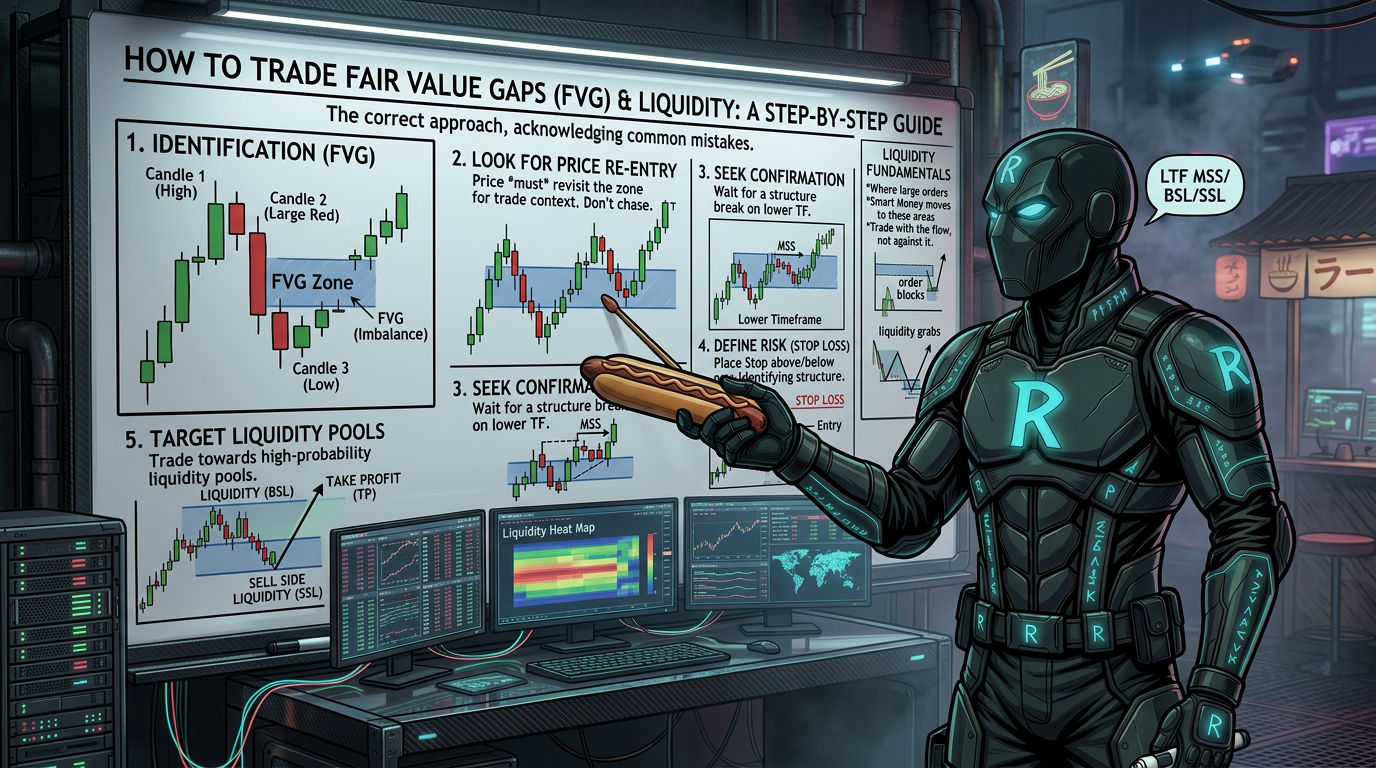
A fair value gap, or FVG, is a price imbalance. It forms when price moves so fast that buyers and sellers do not get a fair chance to trade. It shows up as a three-candle pattern where the wicks of candle one and candle three do not overlap. For a bullish FVG, the high of candle one does not touch the low of candle three. The gap between them is the fair value gap. For a bearish FVG, the low of candle one does not touch the high of candle three. Markets try to balance themselves, so price often returns to fill these gaps before continuing in the original direction.
Why Context Matters More Than the Pattern
You can spot fair value gaps and liquidity pools all day long. But if you trade them without context, you will lose. Context means understanding the bigger picture before you ever look for an entry. Ask yourself three questions. First, is price in a premium zone or a discount zone? Second, what liquidity is price targeting right now? Third, which session is doing the work today? If the market is in a strong uptrend, do not look for shorts. Look for sweeps of lows to go long. Patterns alone mean nothing. Context is what makes them work.
The Three-Step Trade Entry Model
Step one is to establish context and directional bias. Look at higher time frames and decide if you are bullish or bearish for the session. Step two is to wait for a session liquidity raid and a closure. Do not enter the moment a high or low is taken. Wait for price to close back inside the range. If price takes out a low but does not close back above it, skip the trade. Step three is to execute using a fair value gap. After the raid and closure, wait for a fair value gap to form. Place a limit order inside that gap. Put your stop loss below candle one or candle two. Target the opposing session liquidity. All three steps must align. If any one step is missing, do not take the trade.
Bullish Trade Example Walkthrough
You arrive at your chart at 9:30 AM with a bullish bias. You mark the Asian range low and the London range low. You are watching for a raid on one of those lows. Price sweeps the London low just after the open. You wait to see if price closes back above that low. It does. A fair value gap forms on the move higher. You place a limit buy order inside the gap. Your stop loss goes below candle one or candle two. Your target is the Asian range high or the previous day's high. This type of setup has produced reward-to-risk ratios of 2.5 to 1, 3 to 1, and higher in real examples.
Bearish Trade Example Walkthrough
You arrive at your chart with a bearish bias. You mark the London session high. You are watching for a raid above that high. Price spikes above the London high. You wait for a closure back below it. Once price closes back inside the range, you look for a bearish fair value gap. You place a limit sell order inside the gap. Your stop loss goes above candle one or candle two. Your target is the London low or the Asian range low. Some bearish setups using this method have offered reward-to-risk ratios of 4 to 1 and higher. If the gap forms before 9:30 AM on index markets, skip it and wait for a setup after the open.
When to Avoid the Setup
Not every fair value gap is worth trading. Skip the trade if there is no clear directional bias on the higher time frame. Skip it if the liquidity raid happens but price does not close back inside the range. Skip it if the fair value gap forms outside your trading window. For index markets, only trade setups that form after 9:30 AM. For forex, only use setups that form after 8:00 AM. Trading outside those windows leads to worse results based on real performance data. Patience is a core part of this strategy.
Frequently Asked Questions
What is a fair value gap in trading?
A fair value gap is a price zone where very little trading happened. It forms when price moves so fast that buyers and sellers could not trade fairly. It shows up as a three-candle pattern where the wicks of the first and third candle do not overlap. Price often returns to fill this gap before continuing in the same direction.
How is a fair value gap different from a regular gap on a chart?
A regular gap usually happens between the close of one candle and the open of the next, often overnight. A fair value gap happens within a series of three candles during active trading. It is caused by very fast price movement, not just a break in trading hours.
Do I need to trade every fair value gap I see?
No. Most fair value gaps should be ignored. Only trade a fair value gap when it appears after a session liquidity raid, when price has closed back inside the range, and when it matches your higher time frame directional bias. Trading every gap leads to poor results.
What is a session liquidity raid?
A session liquidity raid is when price quickly spikes above a session high or below a session low to trigger resting orders there. It looks like a false breakout. After the raid, price often reverses. This reversal is your signal to look for a fair value gap entry in the opposite direction of the raid.
Where do I put my stop loss when trading a fair value gap?
Place your stop loss below the low of candle one or candle two for a bullish trade. For a bearish trade, place it above the high of candle one or candle two. This keeps your risk tight and defined.
What time of day should I be looking for these setups?
For stock index markets like the NASDAQ, look for setups after 9:30 AM Eastern. For forex markets, look for setups after 8:00 AM Eastern. Setups that form before those times tend to perform worse and are better avoided.
What does directional bias mean and how do I find it?
Directional bias means deciding if you expect price to go up or down for the session. You find it by looking at higher time frame charts, such as the daily or four-hour chart, to see the overall trend. If the market is trending up, you want to look for long setups. If it is trending down, you look for short setups.
Can I use this strategy on any market?
Yes. This strategy works on forex pairs, stock indices, and commodities like gold. The session times and liquidity targets stay the same. Just adjust your trading window to match the market you are trading. For forex, the key window starts at 8:00 AM Eastern. For indices, it starts at 9:30 AM Eastern.